
Encyclopedia
Many organizations still operate separate networks for voice, data, paging, video, and site communication. While that model can work, it often creates duplicated infrastructure, more complex maintenance, and weaker coordination between systems.
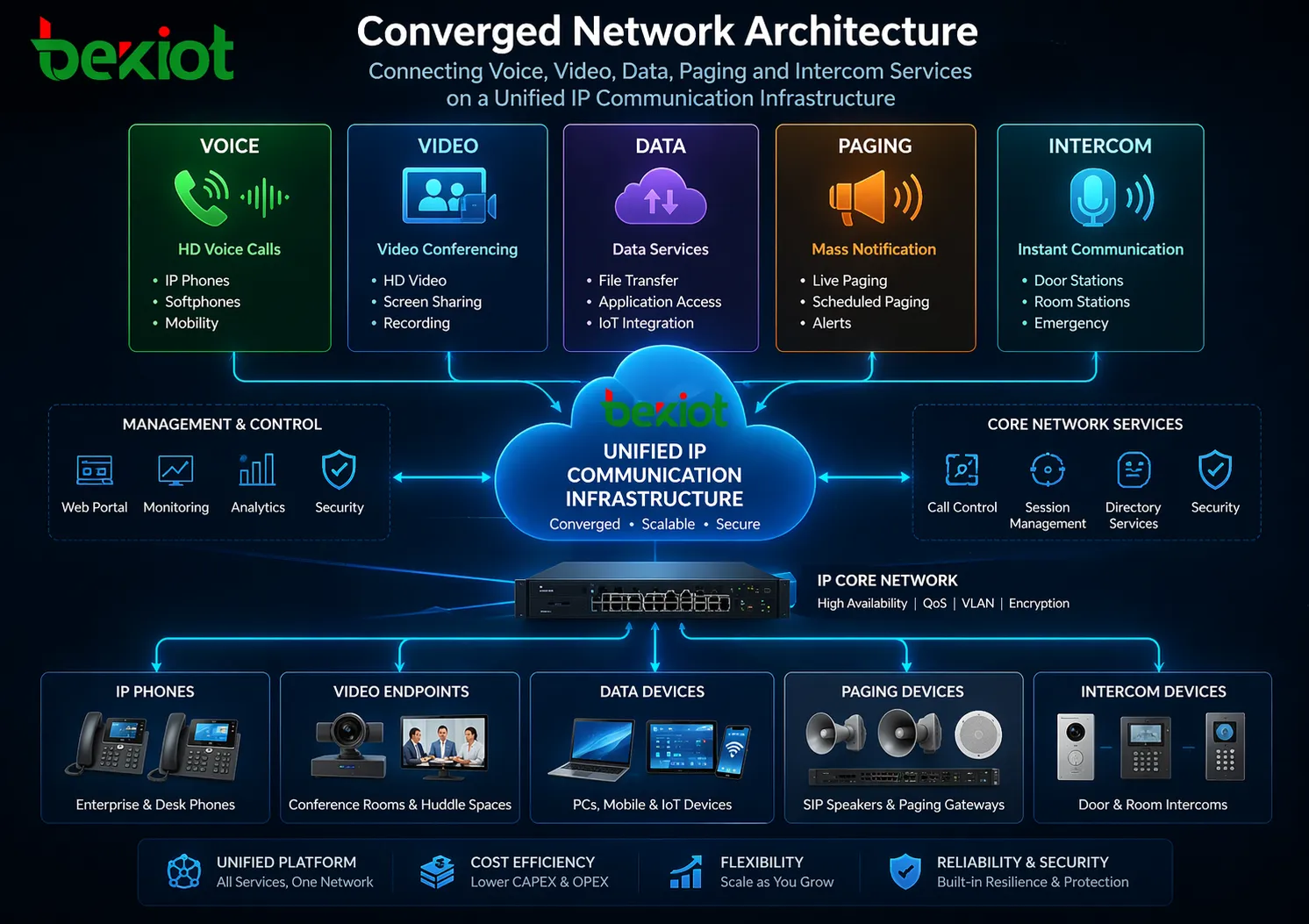
A converged network solves this by carrying multiple communication services over one managed IP infrastructure. It allows voice, video, data, intercom, paging, and related operational traffic to run on a shared network foundation while remaining controlled, prioritized, and easier to scale.

A converged network is a network architecture that supports multiple communication services on the same IP-based infrastructure. Instead of building separate systems for telephony, business data, paging, intercom, video, and other operational communication, organizations use one managed network to carry these services together.
The goal is not simply to place more devices on the same cabling. The real purpose is to reduce silos between systems, simplify administration, and make communication services easier to coordinate. In a converged environment, different traffic types still have different priorities and technical requirements, but they are managed as part of one overall network design.
This makes converged networks especially valuable in environments where communication must move quickly across teams, buildings, or sites. It also makes expansion more practical because new services and endpoints can be added to a common infrastructure rather than to isolated standalone platforms.
A converged network usually runs on a shared Ethernet and IP foundation. Switches, routers, servers, gateways, endpoint devices, and management platforms all connect to the same overall infrastructure. Voice calls, video streams, user data, paging traffic, and intercom communication can then travel across that network according to their own service policies.
Because communication traffic is not all the same, the network must control how each service is handled. Voice and intercom traffic often need low latency and consistent quality. Video may require higher bandwidth. Business applications may be less sensitive to delay but still require stable performance. This is why converged networks commonly use VLAN segmentation, QoS prioritization, bandwidth planning, access control, and security policies to protect service quality.
In practical deployments, a converged network may support IP PBX platforms, SIP phones, intercom terminals, paging gateways, operator consoles, mobile clients, and software-based coordination tools on the same managed architecture. The result is a more centralized communication structure that is easier to maintain and easier to integrate with other systems.
A converged network combines services on one infrastructure, but it still manages each service according to its own performance and operational requirements.
The infrastructure layer includes switches, routers, backbone links, edge access devices, and security controls. This layer provides the shared transport path for all supported services. In many projects, it also includes redundant links or resilient topologies so that communication can continue when one device or path fails.
Power over Ethernet is also common in converged environments because it allows devices such as IP phones, intercom terminals, cameras, and wireless access points to receive both power and network connectivity through the same cable.
Above the transport network, organizations typically deploy communication control platforms such as IP PBX servers, SIP platforms, dispatch systems, media services, and centralized management software. These platforms control call routing, device registration, paging groups, conferences, service policies, and other communication functions.
In larger deployments, this layer may also connect with video management platforms, alarm interfaces, access control systems, and operational software so that communication is linked to a wider response workflow.
The endpoint layer includes the devices people use every day. These may include desk phones, SIP intercoms, paging speakers, emergency help points, operator consoles, wireless clients, and voice gateways. In industrial or field environments, the endpoint layer may also include rugged communication devices designed for harsh site conditions.
This layer is where network convergence becomes visible in daily use. Different devices serve different purposes, but they all rely on one coordinated network structure rather than on isolated communication systems.
Separate communication systems often lead to repeated cabling, repeated interfaces, repeated maintenance tasks, and separate troubleshooting processes. A converged network reduces that duplication by giving multiple services a shared infrastructure base.
This does not remove the need for service-specific control. It simply removes much of the unnecessary separation between systems that could otherwise be managed in a more unified way.
When communication services run on a common network, administrators and operators can manage them more consistently. This helps with monitoring, configuration, upgrades, policy enforcement, and expansion planning across multiple buildings or sites.
Centralized control also improves visibility. Instead of dealing with disconnected systems one by one, teams can manage communication from a more coordinated operational perspective.
One of the strongest benefits of convergence is that voice, paging, intercom, dispatch, and related services can work together more naturally. This helps organizations reduce delays between systems and improve communication flow between field devices, operators, and management platforms.
That interoperability is especially useful where communication must move quickly between departments, control rooms, maintenance staff, and emergency response personnel.
Organizations rarely stay fixed in one building forever. They expand across floors, campuses, production areas, branches, or remote facilities. A converged network supports this growth more effectively because new devices and services can be added to an existing architecture instead of requiring a separate new system each time.
This makes long-term planning more practical and helps prevent a new generation of isolated platforms from appearing as the organization grows.
Real-time communication depends on reliability, priority control, and consistent performance. When converged networks are designed correctly, they provide a stronger foundation for voice, intercom, paging, and operational coordination than fragmented systems that are hard to align.
This is one reason converged network design has become increasingly important in communication-heavy environments where speed and coordination matter.

In a traditional model, voice, data, paging, video, and site communication may each run on different infrastructure. That can make sense in older environments, but it often leads to duplicated cabling, isolated administration, limited interoperability, and slower troubleshooting. Expansion also becomes harder because each new service may require its own platform and its own maintenance process.
A converged network uses a shared IP-based foundation instead. The services remain distinct in function, but they are no longer isolated in architecture. This makes it easier to coordinate communication, integrate new endpoints, and manage service growth over time.
The larger and more distributed the environment becomes, the more visible this difference usually is. Small standalone systems may work for a while, but multi-building and multi-site operations often gain more value from a converged design because it supports both integration and scale.
Traditional separate networks divide services by infrastructure. Converged networks keep the services distinct but bring them together on one managed architecture.
Office buildings, corporate campuses, and educational environments often need desk telephony, wireless connectivity, intercom, paging, and business applications to work together. A converged network helps support these services through one structured architecture and makes day-to-day management more consistent.
It is also useful where multiple departments or buildings must maintain common communication standards without operating separate networks for each service.
Hospitals, clinics, and public service facilities often rely on fast internal communication, notifications, paging, and operational coordination. A converged network supports these needs by allowing multiple communication functions to share one managed foundation while preserving service priority.
In such environments, communication quality is closely tied to service continuity and response efficiency.
Stations, tunnels, rail systems, airports, and utility facilities typically include distributed communication points, operator positions, public-facing communication, and internal coordination workflows. A converged network helps connect these elements more consistently across wide physical areas.
This makes it easier to link field devices with central platforms and maintain a more unified communication model across the project.
Factories, ports, mines, processing plants, and energy facilities often depend on reliable communication between control rooms, production areas, maintenance teams, and emergency points. A converged network can serve as the backbone for industrial telephony, SIP intercom, paging, gateway access, and dispatch-related communication.
In these environments, convergence is not just about efficiency. It is also about creating a more coordinated and dependable communication structure for operations and response.
Not all traffic should be treated the same. Voice, intercom, and other real-time services need predictable performance, which means QoS planning is essential. Without it, service quality can degrade when the network becomes busy.
Good converged network design starts with traffic awareness rather than assuming all applications can share the same path without policy control.
Bringing more services onto one infrastructure increases the importance of network security. Organizations often need segmentation, access control, authentication, traffic monitoring, and policy enforcement to protect communication systems while still allowing integration where needed.
Strong convergence does not mean weak boundaries. It means controlled interoperability inside a protected architecture.
If communication is operationally important, the network should not depend on a single switch, link, server, or power source. Redundant paths, resilient hardware, backup power planning, and high-availability platform design can all be necessary in communication-critical projects.
This matters even more in environments that rely on emergency communication or central operator coordination.
A converged network should be designed with long-term interoperability in mind. Organizations should consider protocol compatibility, gateway requirements, third-party integration, and future service expansion before deployment begins.
This helps avoid creating hidden technical barriers inside what is supposed to be a unified communication architecture.
Becke Telcom supports converged network projects with integrated communication solutions that combine IP telephony, SIP intercom, paging systems, emergency communication terminals, voice gateways, and dispatch platforms on one coordinated IP architecture.
This makes it easier for operators to manage communication across buildings, production areas, control rooms, and remote sites without relying on fragmented standalone systems. It also helps organizations build a more structured communication environment for both daily coordination and time-sensitive response workflows.
For industrial, transportation, campus, healthcare, and public service environments, Becke Telcom supports a more unified communication model that connects field communication devices with centralized control and operational visibility.

A converged network is a practical way to carry voice, video, data, paging, intercom, and related communication services over one managed IP infrastructure. When designed well, it reduces system silos, improves coordination, simplifies expansion, and supports more reliable real-time communication across complex environments.
As communication systems continue to expand across departments, buildings, and sites, converged network design becomes more important as an operational foundation. For organizations planning a more unified communication architecture, Becke Telcom provides practical converged communication solutions designed for reliable daily operation and structured emergency response.
No. A converged network refers to the shared infrastructure that carries multiple services over one managed IP platform. Unified communications usually refers to the user-facing communication tools and workflows that run on top of that infrastructure.
A converged network can support voice, video, business data, intercom, paging, messaging, dispatch-related communication, and other IP-based services depending on the design.
QoS is important because real-time services such as voice and intercom require low latency and stable delivery. Without traffic prioritization, these services can be affected by heavier data or video traffic.
They are commonly used in enterprise campuses, healthcare facilities, transportation projects, industrial sites, public service environments, and other locations that require centralized communication across multiple services.
Becke Telcom can help by integrating IP phones, SIP intercoms, paging systems, emergency communication endpoints, voice gateways, and dispatch platforms into one coordinated IP-based communication solution.