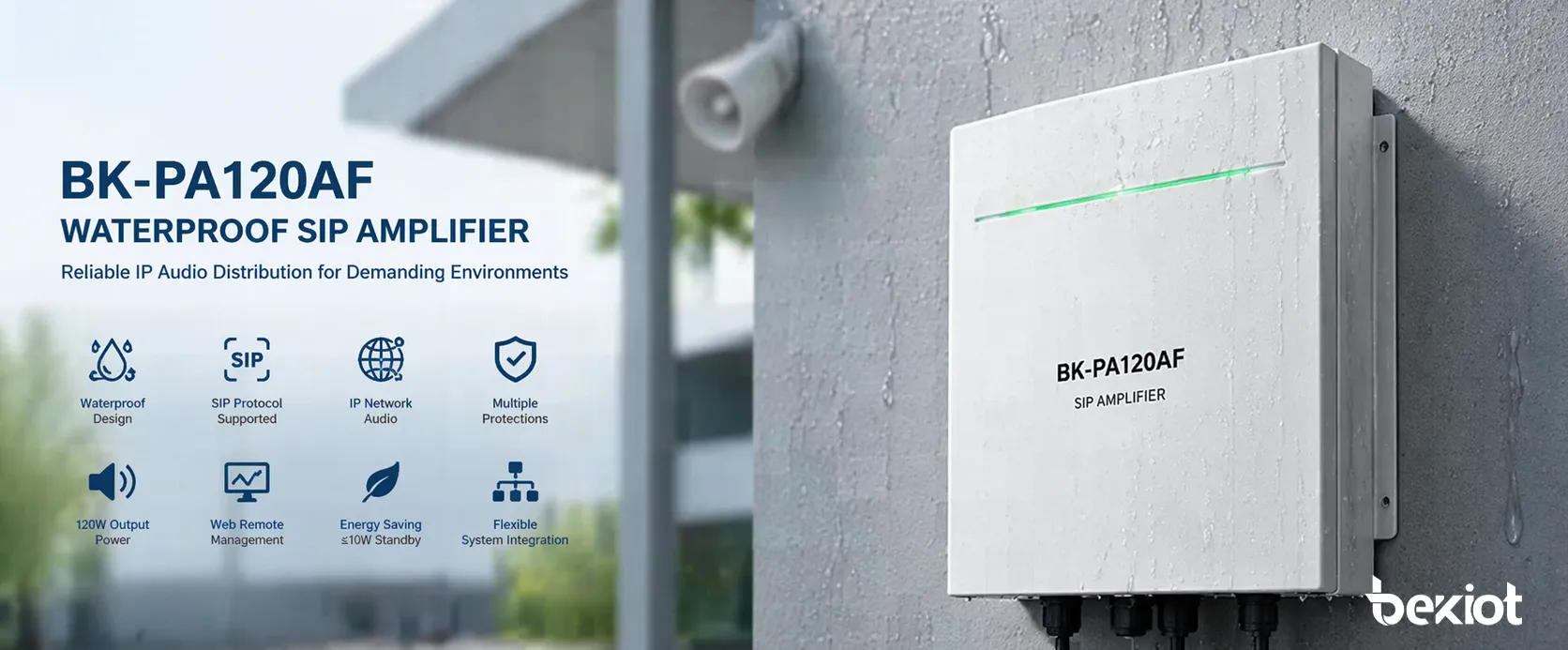

Becke BK-PA120AF is a waterproof SIP amplifier designed for dependable network audio distribution, paging, and emergency broadcasting in practical projects where stability matters as much as sound performance. Unlike standard indoor amplifiers that focus only on output power, this model is positioned as a field-ready SIP amplifier that combines network connectivity, flexible broadcast control, efficient power amplification, and dependable protection in one compact platform.
It is built for users who need more than simple amplification. In schools, industrial sites, transport facilities, public buildings, scenic areas, and distributed commercial spaces, the amplifier often has to work as part of a larger IP audio system. That means it must receive commands from servers, SIP platforms, mobile apps, control clients, or third-party software, while maintaining stable audio transmission and consistent output quality. BK-PA120AF is designed around that real requirement.

The value of BK-PA120AF is not only that it can amplify audio. Its strength is that it can function as an active endpoint in an IP broadcasting system. It supports multiple task delivery methods, allowing background music, scheduled playback, TTS announcements, emergency paging, and alarm broadcasting to be triggered through a broadcast server, control client, mobile application, or third-party platform. This makes deployment much more flexible for modern projects that rely on centralized management and distributed operation.
Because the amplifier is SIP-enabled, it can fit naturally into IP audio architectures that already use SIP intercoms, SIP phones, network paging stations, or command-and-dispatch platforms. This is especially useful in projects where voice communication and public address need to work together instead of operating as isolated subsystems.
BK-PA120AF is designed for users who want a waterproof SIP amplifier that can be managed remotely, deliver stable audio, and remain easy to integrate into wider IP paging and emergency broadcast systems.
One of the most important differences of BK-PA120AF is its waterproof positioning. This gives the amplifier broader installation value in environments where ordinary office-grade devices are not the best fit. In many real projects, the equipment room is not always a perfectly controlled indoor cabinet space. Moisture, dust, changing temperatures, and semi-exposed installation conditions can all affect long-term reliability. A waterproof SIP amplifier helps reduce those risks and supports more confident deployment.
This also makes the product a better choice for corridor equipment points, sheltered outdoor service areas, transport-side installations, campus edge locations, public infrastructure rooms, warehouse passages, and other places where audio coverage is needed but environmental conditions are less forgiving than a standard IT room.
The amplifier uses a domestic dual-core ARM Cortex-A7 processor running up to 1.2GHz, forming a fully localized core hardware design for stronger controllability and long-term platform stability. Combined with a deeply customized Linux operating system, the device is built for reliable continuous operation, with a system design focused on robust performance and long service life.
Its built-in watchdog monitoring mechanism further improves resilience by helping the device maintain stable service in continuous-use scenarios. For projects that run scheduled announcements every day, background audio for long periods, or emergency broadcast functions that must remain available when needed, this kind of architecture is a meaningful advantage.
BK-PA120AF adopts class-D power amplifier technology together with a full-loop feedback network to reduce distortion and improve overall output control. In practical use, that means the amplifier is not only efficient, but also more stable when handling higher power output. It is well suited for distributed public address points where voice clarity and output consistency are both important.
The product is also designed to preserve audio integrity while remaining flexible in operation. For installers and system designers, that balance matters because the amplifier may need to handle routine music, voice paging, warning tones, and urgent announcements in the same system.
The dual-PFC switching power supply design improves amplifier performance while reducing power current consumption. Support for a wide voltage range from AC90V to AC265V helps the unit adapt to different power conditions and global deployment requirements. This is useful for international projects and for sites where power quality may fluctuate.
In addition, the amplifier supports intelligent energy-saving behavior. When there is no signal, it can automatically enter standby mode, with standby power consumption at or below 10W. For projects with many distributed audio points, this helps reduce operating cost over time while supporting greener system design.

BK-PA120AF supports a wide range of broadcast task types. It can be used for background music distribution, scheduled announcements, text-to-speech broadcasting, emergency paging, and alarm broadcast execution. Instead of limiting operators to a single control path, the amplifier can receive commands through broadcast servers, control clients, mobile apps, and third-party applications.
This flexibility helps system owners build operating logic that matches the site. A school may use scheduled bells and routine public notices. A transport or industrial site may prioritize emergency paging and alarm linkage. A commercial or public facility may mix background audio with live announcements. The same amplifier platform can support these different service modes within one network architecture.
The amplifier provides a complete web-based remote management interface. By accessing the device IP address through a browser, users can perform real-time control, adjust volume, and restart the equipment remotely. This is important in projects where devices are distributed across multiple rooms, floors, buildings, or sites.
Through the web interface, users can also configure core system parameters more efficiently, including audio settings, permission management, system configuration, and firmware upgrades. This reduces maintenance pressure and improves the speed of commissioning, troubleshooting, and later optimization.
BK-PA120AF integrates a network audio codec module and supports multiple protocols including TCP/IP, UDP, SIP, and HTTP. This gives the product strong compatibility for deployment inside modern IP infrastructures. It can transport 16-bit stereo CD-grade audio and supports MP3 and WAV formats, making it suitable for both spoken announcements and routine audio content.
The amplifier also supports DHCP and can work across a wide range of network structures, including routers, switches, bridges, gateways, modems, internet-based connections, and different bearer environments such as 2G, 3G, 4G, and 5G. It also supports multicast and unicast transmission modes, which gives designers more freedom when planning bandwidth use and network topology.
The device includes one AUX input with independent volume control and one auxiliary audio output for expanding with an external power amplifier. This makes it easier to adapt the amplifier for project-specific requirements without redesigning the entire audio chain. Standard RCA interfaces also simplify field wiring and installation.
Because the system architecture is fully digital and network-based, expansion is convenient and is not heavily limited by geographic distance. Existing network resources can be reused, which helps lower deployment cost and simplify scaling for growing projects.
In public address and emergency broadcasting, reliability is often more important than headline specifications. BK-PA120AF is designed with several practical protective and operational measures that directly support long-term field use. It supports soft start on power-up to avoid sudden inrush current and reduce interference with other electrical equipment on the same line. This is a useful detail for installations in shared power environments.
The amplifier also uses intelligent thermal management. The cooling system adjusts according to temperature conditions, keeping fan noise low while maintaining effective heat dissipation. When the heatsink temperature reaches the working threshold, the built-in fan starts automatically. This supports stable operation without relying on constant manual oversight.
Protection is another strong point. The unit includes multiple intelligent detection and protection mechanisms covering soft start, DC protection, short circuit, overheating, overload, and limiting. Working status indicators, including level indication, protection indication, and standby indication, help operators understand device condition quickly. Lightning protection with 4KV surge resistance further improves suitability for demanding installations and infrastructure-oriented projects.
For many customers, the real advantage of BK-PA120AF is that it is not just network-connected and powerful on paper. It is designed to keep working reliably in distributed projects where maintenance access, power conditions, and environmental stress are real concerns.
BK-PA120AF is well suited to school broadcasting networks that require scheduled bells, classroom announcements, campus paging, and emergency notification. With remote web management and network-based task delivery, administrators can manage audio distribution more efficiently across teaching buildings, corridors, playground areas, and service zones.
In industrial and logistics environments, operators often need routine announcements, area paging, alarm linkage, and reliable voice output across wide spaces. The waterproof design, protective features, and broad power adaptability make the amplifier a practical choice for these working conditions.
Stations, terminals, public buildings, corridors, utility rooms, and distributed service areas can all benefit from IP-based amplification that supports centralized control and remote maintenance. BK-PA120AF helps extend paging and broadcast capability to points where a standard indoor amplifier may be less suitable.
For scenic areas, commercial buildings, mixed-use compounds, and public-facing sites, the amplifier can support background music, routine announcements, and emergency broadcast functions through the same network platform. This is useful for operators who want one manageable audio infrastructure instead of several isolated systems.

BK-PA120AF provides a standard RJ45 network interface with 100Mbps transmission, supports TCP/IP, UDP, SIP, and HTTP, and handles MP3 and WAV audio in 16-bit stereo quality with sampling rates from 8K to 48K. The rated power is 120W, with 100V constant-voltage output. It supports wide-range AC power input from 90V to 265V, includes forced air cooling, and is housed in an SPCC cold-rolled steel chassis with compact dimensions for flexible installation.
An optional RS485 monitoring module is available for projects that require real-time amplifier status monitoring and more centralized intelligent management.
The main difference is its waterproof positioning combined with SIP capability, web management, and practical protection design. It is better suited for distributed real-world projects where remote control, stable network integration, and stronger environmental adaptability are needed.
Yes. It supports background music, scheduled broadcasting, TTS announcements, emergency paging, and alarm broadcasting. This allows one amplifier platform to handle everyday audio tasks and urgent notification requirements in the same system.
Yes. The built-in web interface allows users to access the device through its IP address for real-time control, parameter configuration, volume adjustment, firmware upgrade, and restart operations. This reduces the need for on-site maintenance.
It is a strong fit for campuses, industrial plants, warehouses, transport facilities, scenic areas, public buildings, and other distributed IP audio projects that need reliable network broadcast capability, centralized management, and practical field durability.