
IndustryInsights
Clear communication matters most when people need to hear a message quickly, understand it immediately, and know what to do next. That is why the paging system speaker is more than a simple audio endpoint. In a modern facility, it is the final and most visible part of the paging chain, turning live voice announcements, scheduled notices, alerts, and emergency instructions into intelligible sound across the places where people actually work, move, study, or seek care.
A paging system speaker may look straightforward on the surface, but the right choice depends on far more than appearance. Indoor and outdoor coverage, background noise, mounting position, network architecture, zoning requirements, and integration with telephony or emergency communication systems all influence which speaker is the best fit. In older sites, a speaker may be part of a conventional PA line. In newer deployments, it may operate as an IP or SIP endpoint connected directly to the network.
This guide explains what a paging system speaker is, the main types used today, where they are commonly installed, and how to choose the right model for practical, long-term performance. It also shows why modern organizations increasingly prefer paging speakers that work with IP PBX, paging servers, intercom platforms, and hybrid paging environments.

A paging system speaker is the audio output device used to broadcast live or prerecorded voice messages to a defined area. It is commonly used in schools, factories, warehouses, hospitals, offices, transport hubs, retail sites, and large industrial facilities where one-to-many communication must be delivered clearly and quickly. In simple terms, it is the part of the paging system people hear.
However, the speaker itself is only one part of the communication path. A message may originate from a microphone, a paging console, an IP phone, a dispatch workstation, or a software-based paging interface. The audio is then processed and routed through an amplifier, a paging controller, or an IP network before being reproduced by the speaker in one or more zones. The speaker therefore sits at the end of a chain, but it strongly influences whether the message succeeds or fails.
The real job of a paging speaker is not simply to make sound. Its job is to make the message understandable where it matters.
That distinction is important. A loud speaker is not always an effective paging speaker. In many environments, speech intelligibility matters more than raw volume. A model that works well in a quiet office corridor may perform poorly in a loading bay, a machine room, or an outdoor yard. This is why paging speaker selection should always be tied to the communication objective, the acoustic conditions, and the system architecture behind it.
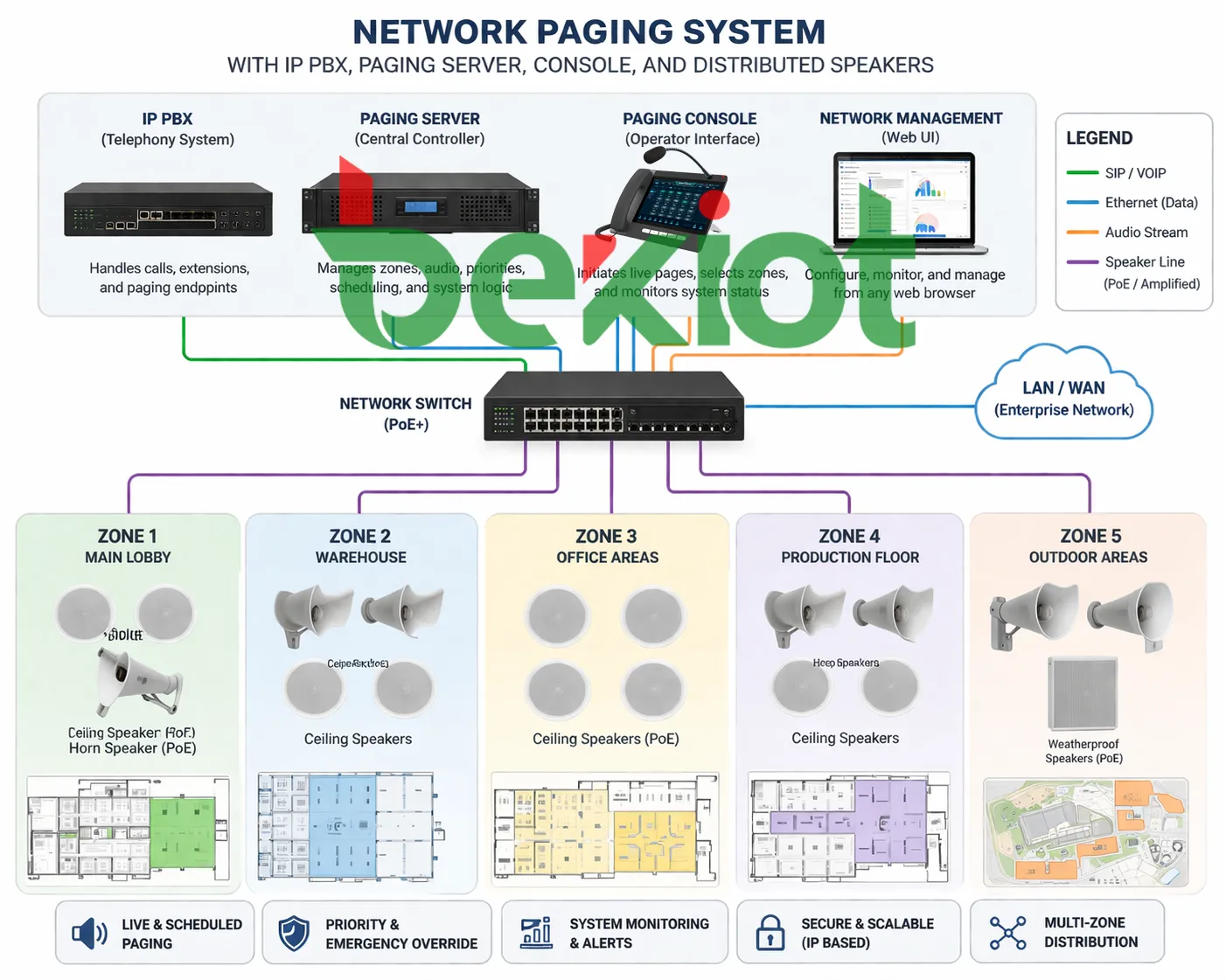
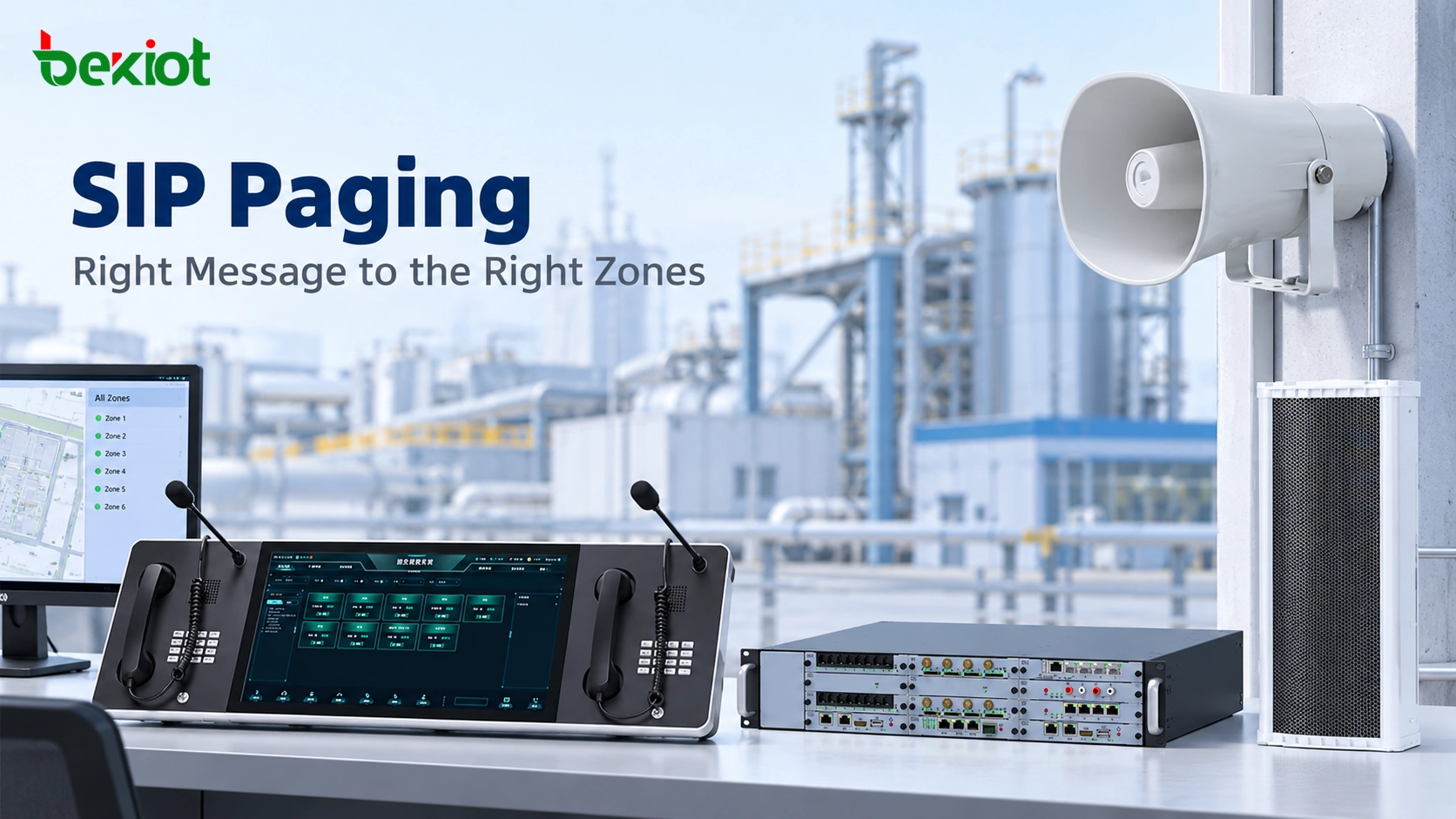
To understand how to choose the right speaker, it helps to view it in the context of the complete paging system. In a typical workflow, a user places a page from a phone, microphone, paging console, or software interface. The audio is then routed through the communication platform and delivered to the selected zone or group of zones. The paging speaker receives that signal and plays it in the target space.
In a traditional analog setup, speakers are usually connected to a paging amplifier and distributed over speaker lines. In an IP environment, speakers may connect directly to the Ethernet network and receive audio over SIP or multicast. In a hybrid design, paging adapters can bridge older amplifiers and analog speaker infrastructure into a more modern IP-based system. This hybrid approach is often attractive when an organization wants to modernize gradually instead of replacing everything at once.
The speaker therefore affects not only audio coverage but also deployment flexibility. A network speaker may simplify wiring, zoning, and remote management. A conventional speaker may still be a sound choice in facilities with a stable legacy paging backbone. The right decision depends on whether the project is a new build, an expansion, or an upgrade of an existing site.
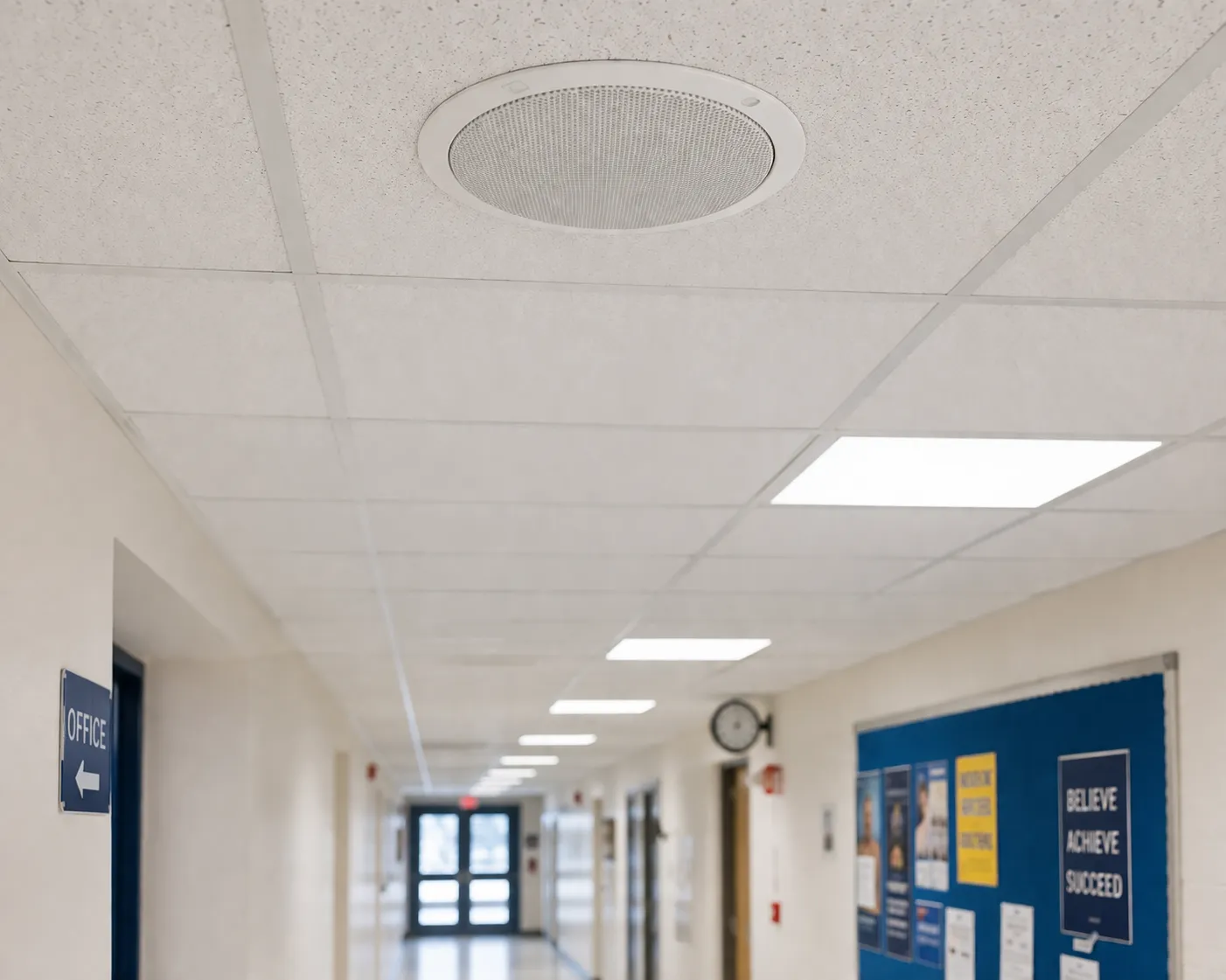
Ceiling speakers are one of the most common choices for indoor paging. They are widely used in school corridors, office areas, reception zones, clinics, stores, classrooms, hallways, and general circulation spaces where a neat appearance and even sound distribution are important. Because they are installed overhead, they help maintain a clean visual design while covering regular indoor areas effectively.
These speakers are often selected when the goal is broad, non-intrusive voice coverage rather than extreme sound pressure. In environments such as schools or commercial buildings, ceiling speakers can deliver day-to-day notices, scheduled tones, operational announcements, and emergency instructions without taking up wall space or interfering with pedestrian movement.
For modern projects, ceiling speakers are also available in SIP or IP formats, making them suitable for installations where the organization wants network-based paging, PoE power, and easier integration with phones, paging servers, or unified communication platforms.
Wall-mounted and cabinet-style paging speakers are often used where more directional coverage is needed or where ceiling mounting is impractical. They are common in lobbies, waiting areas, workshop entrances, retail spaces, stairwells, and multi-purpose rooms. Their placement makes them useful when the message needs to be aimed more directly into a defined listening area.
These speakers can be especially helpful in retrofit projects. Some older buildings do not offer easy ceiling access, or the ceiling height may reduce clarity for ordinary paging. A wall speaker can be easier to install, simpler to maintain, and more effective in a specific zone where speech directionality matters.
In IP-based environments, wall speakers may also support additional capabilities such as multicast reception, paging prioritization, visual status indication, or integration with broader alerting workflows. That makes them attractive for both general announcements and higher-priority operational messaging.
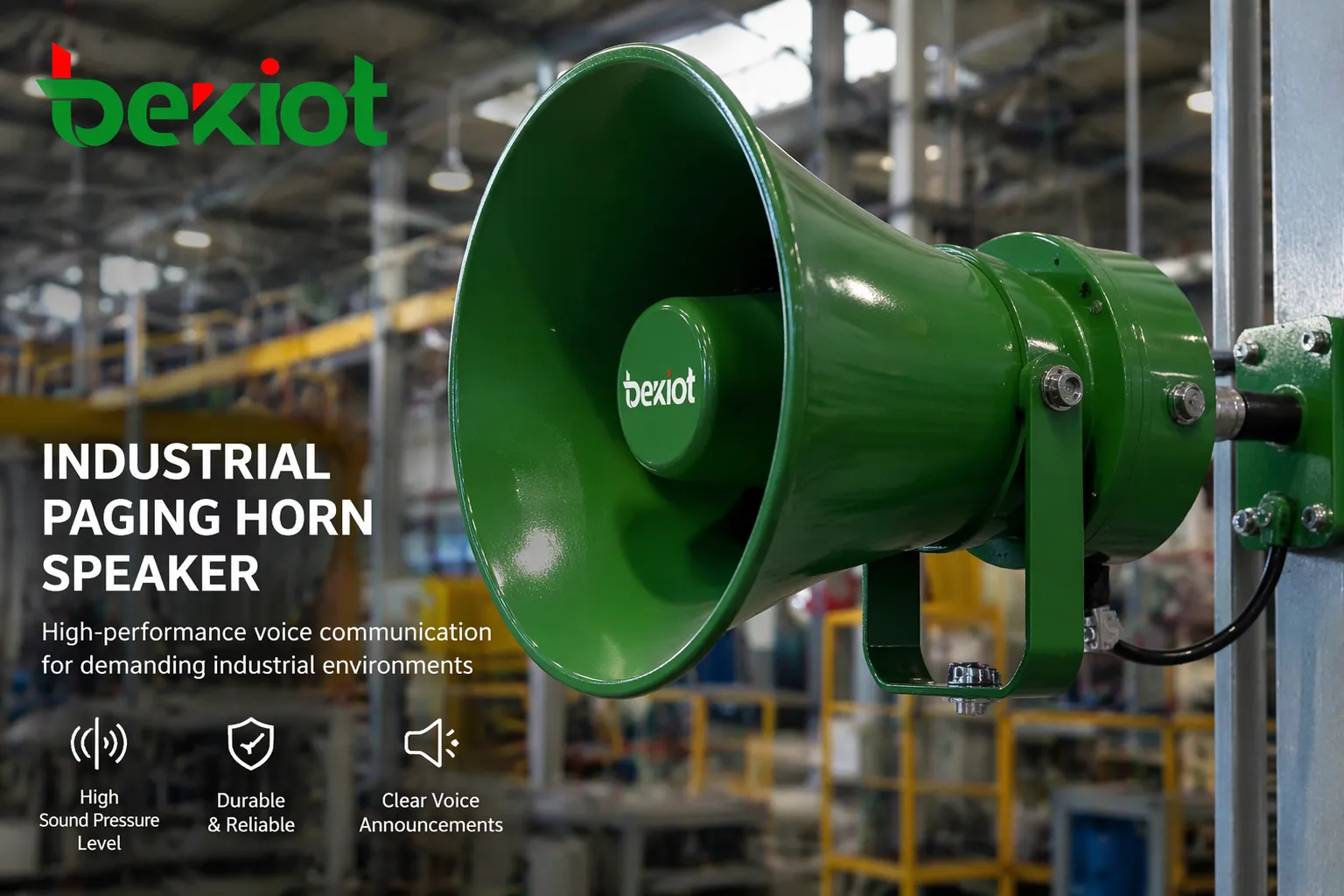
Horn speakers are typically chosen for factories, loading docks, outdoor yards, parking areas, ports, depots, utility sites, and other locations where background noise is high or the message must travel farther. Their design supports more focused projection, which helps voice announcements cut through challenging acoustic conditions.
In industrial facilities, standard indoor speakers may struggle to overcome machinery, ventilation systems, vehicle movement, or open-space sound loss. A paging horn is often the better choice in those situations because it is built for practical audibility and rugged application. Some models are also suitable for weather-exposed installations when the environment demands outdoor coverage.
When a site includes both quiet and noisy areas, horn speakers are often combined with ceiling or wall speakers in a zoned design. That approach avoids overengineering the quieter spaces while still providing sufficient performance in demanding areas.

In education environments, paging speakers are used for daily announcements, class change notifications, attendance calls, administrative messaging, and emergency instructions. Coverage consistency matters because the system may need to serve corridors, classrooms, reception areas, cafeterias, sports spaces, and outdoor circulation zones.
Schools also benefit from zoning. Not every announcement should go everywhere. A paging system may need to target one building, one floor, one wing, or the full campus. That makes speaker placement and system design equally important. A speaker that performs well in a classroom corridor may not be the right choice for a gym entrance or an outdoor pickup zone.
Because schools increasingly connect communication, security, and notification functions, IP-based paging speakers can fit naturally into broader campus communication plans that include phones, intercoms, emergency alerts, and centralized administration.
Industrial sites often present the toughest requirements for paging audio. High ambient noise, large open volumes, reflective surfaces, equipment vibration, and outdoor transition areas all affect performance. In these spaces, the paging speaker is not only a convenience tool. It is often part of the operational and safety communication chain.
Factories may use paging speakers for production announcements, team coordination, shift notices, evacuation instructions, equipment-related alerts, and zone-based operational communication. Warehouses often rely on paging for loading activities, dock coordination, internal logistics, and urgent voice notifications.
In such settings, durability, coverage strategy, and intelligibility are more important than appearance. This is why industrial projects frequently mix horn speakers, wall speakers, and legacy amplifier integration depending on the acoustic profile of each area.
Hospitals and clinics need clear, controlled communication in spaces where speech must be audible without becoming disruptive. Offices need efficient voice announcements for visitor handling, building-wide notices, or facility operations. Stations and transport hubs need clear broadcast to moving groups of people across multiple zones.
Although these environments differ, they share one need: messages must reach the right people without unnecessary confusion. That is why speaker type, zone logic, and message priority must be planned together. In healthcare, clarity and discretion are both important. In office settings, aesthetics and integration may matter more. In transport environments, wide-area intelligibility often becomes the top priority.
A good paging speaker strategy recognizes those differences instead of applying one speaker style across every space.
The first question is always practical: can people actually understand the page? Strong paging performance depends on more than output level. Room shape, ceiling height, background noise, surface reflectivity, and speaker placement all affect intelligibility. A smaller, well-positioned speaker may outperform a louder but poorly matched one.
Coverage should also be realistic. Oversized speaker spacing can leave dead spots. Overly aggressive volume can create harshness and listener fatigue. The better approach is to match the speaker type to the listening environment and design the coverage pattern accordingly.
For that reason, many successful installations treat paging speakers as part of an acoustic layout rather than as isolated products. The objective is consistent comprehension, not simply wide distribution of sound.
Modern paging projects increasingly look for network-ready features. SIP compatibility can allow a speaker to work more naturally with IP PBX or VoIP systems. PoE can simplify installation by carrying power and data over one network cable. Multicast can improve efficiency when one page must be distributed to many endpoints simultaneously. Zone support helps operators send the right message to the right area.
These capabilities are especially valuable in larger or growing facilities. They can reduce cabling complexity, support centralized management, and make future expansion easier. Instead of treating each broadcast point as a separate standalone device, the system can be managed more cohesively across the site.
For organizations that already use IP telephony or plan to unify voice applications, a paging speaker with these features often provides better long-term value than a speaker chosen only for its initial hardware cost.
When the paging system is part of the network, the speaker becomes part of the communication platform rather than just the sound system.
Not every project begins from zero. Many facilities already have analog speakers, amplifiers, or overhead paging circuits in place. In those cases, it may be more efficient to extend the life of the existing infrastructure while adding IP control, SIP paging access, or zoned distribution through adapters and hybrid interfaces.
This matters because replacement cost is not the only project cost. Downtime, rewiring, ceiling work, operational disruption, and retraining all carry real impact. A speaker strategy that respects what is already installed can produce a more practical modernization path.
It is also worth considering how the paging speaker participates in emergency communication. In many facilities, paging overlaps with alerting, evacuation messaging, critical notifications, and coordinated site response. The speaker should therefore be selected not only for daily convenience but also for reliable performance during urgent events.
A standard PA speaker is often part of a conventional amplifier-based audio chain. It may work perfectly well for voice paging in many environments, especially where existing infrastructure is stable and simple. A paging system speaker, however, increasingly refers to a speaker chosen specifically for operational paging tasks and, in many cases, for network-connected deployment.
The difference becomes clearer in modern systems. An IP or SIP paging speaker may support direct network connectivity, PoE, multicast, endpoint registration, zoning logic, and integration with telephony or alerting platforms. A conventional PA speaker typically depends more heavily on centralized amplification and line distribution.
Neither approach is automatically better in every case. The more useful question is whether the facility needs simple analog paging, flexible network-based paging, or a hybrid model that combines both. That answer will shape the right speaker decision more accurately than product labels alone.
The most common mistake in paging projects is choosing the speaker before defining the listening conditions. Start by identifying whether the zone is quiet, moderately active, highly noisy, indoor, outdoor, reverberant, or open to the weather. Also determine whether the area is public-facing, staff-only, industrial, educational, or mixed-use.
This environmental view quickly narrows the speaker type. Ceiling speakers may serve corridors and offices well. Wall speakers may fit targeted indoor zones. Horn speakers may be necessary in workshops, yards, or logistics areas. Once the environment is clear, the technical shortlist becomes much more accurate.
That approach also reduces overspending. A facility does not need industrial horn coverage in every room, nor should it expect light-duty indoor speakers to solve high-noise paging problems.
After the acoustic environment, look at the communication architecture. Is the site using a legacy amplifier, an IP PBX, a paging server, a SIP-based voice platform, or a mixed system? Does the project need one-way paging only, or should it support talk-back, alerting, or wider emergency communication workflows?
If the system is already moving toward network convergence, an IP or SIP paging speaker may align better with future plans. If the facility depends on a stable analog backbone, a hybrid path may be more practical. The speaker should support the operational model, not force the project into unnecessary redesign.
Think beyond the first installation phase as well. Many sites start with a few zones and later expand. Choosing speakers and interfaces that support phased growth can save considerable effort later.
A speaker is easy to overlook because it seems passive, but paging systems live in real buildings with real maintenance needs. Accessibility, serviceability, replacement planning, and standardization should all be considered before final selection. A technically impressive model is not always the best choice if it complicates deployment or maintenance across dozens of zones.
It is also wise to think about user experience. Operators need logical zoning, clear broadcast behavior, and dependable output. End users need clear, intelligible messages. Facility teams need equipment that can be supported without excessive complexity.
The best paging speaker choice is usually the one that remains practical after installation day, not just the one that looks best on a specification sheet.

As facilities become more connected, paging speakers are increasingly expected to work with more than a microphone and an amplifier. They may need to integrate with IP telephony, SIP paging, zone control, intercom points, emergency communication workflows, and centralized management across multiple buildings or departments.
That is where a broader solution perspective becomes valuable. Instead of viewing the speaker as a standalone endpoint, organizations can treat it as one element within an integrated voice communication architecture. This can support cleaner expansion, more flexible zoning, and better coordination between daily operations and critical response communication.
For projects that need this kind of deployment model, Becke Telcom can support paging speaker planning together with SIP/IP communication devices, paging adapters, intercom terminals, broadcast endpoints, and integrated communication solutions for schools, factories, hospitals, offices, transport sites, and industrial facilities. The goal is not simply to add more speakers, but to build a paging path that is reliable, intelligible, and easier to manage over time.
A well-designed paging system speaker solution should sound clear on ordinary days and remain dependable on critical ones.
A paging system speaker is one of the most practical communication devices in a facility because it turns system design into real-world action. It is the point where a live page, a scheduled notice, or an urgent instruction finally reaches people in the spaces where decisions and movement happen.
The right choice depends on understanding the environment, the communication workflow, and the wider system behind the speaker. Ceiling, wall, and horn speakers each serve different needs. Traditional PA and modern IP/SIP paging approaches each have their place. The best result comes from matching the speaker to the application instead of expecting one type to do everything equally well.
If you are planning a new paging deployment or upgrading an existing site, a practical next step is to define the zones, the acoustic conditions, and the integration requirements first. From there, Becke Telcom can help align the speaker type, paging method, and communication architecture for a solution that is easier to deploy and more dependable in daily operation.
A paging system speaker is used to broadcast voice announcements, notices, alerts, and emergency instructions to one area or multiple zones within a facility. It is commonly used in schools, offices, factories, warehouses, hospitals, and transport sites.
A normal speaker may be designed mainly for music or general audio playback, while a paging speaker is selected for clear voice communication in operational environments. Many modern paging speakers also support installation and control features that fit paging systems more effectively.
Ceiling speakers are usually better for indoor corridors, offices, classrooms, and similar spaces with moderate noise levels. Horn speakers are usually better for factories, warehouses, yards, and outdoor or high-noise areas where stronger projection is needed.
Yes. Many modern paging speakers are designed for SIP or IP-based environments and can work with IP PBX platforms, paging servers, or other network-based communication systems, depending on the deployment model.
Yes. Many facilities upgrade through a hybrid approach, keeping existing amplifiers or analog speakers while adding IP paging adapters, zoned control, or SIP-based access. This can reduce replacement cost and simplify phased modernization.
Start with the environment, the noise level, the mounting conditions, and the communication platform you want to use. Then match the speaker type to the zone and confirm whether you need features such as PoE, SIP, multicast, zoning, or legacy system integration.