
Encyclopedia
LLDP-MED is a standards-based extension of LLDP designed for media endpoint devices such as IP phones. In practical terms, it helps an IP phone learn critical access-layer information from the switch it is connected to, including voice VLAN policy, Layer 2 and Layer 3 priority settings, power-related information, inventory details, and sometimes location data. In modern voice deployments, that makes LLDP-MED an important part of zero-touch phone rollout.
At the same time, LLDP-MED is often misunderstood. It does not replace the full provisioning workflow of an IP phone. It does not normally deliver the complete SIP account, PBX server list, firmware package, or every device parameter by itself. Instead, it acts as an early discovery mechanism that helps the phone join the right network segment and receive the right treatment before the rest of the provisioning process begins.
LLDP-MED stands for Link Layer Discovery Protocol for Media Endpoint Devices. It was developed to extend the baseline LLDP framework for VoIP and related endpoint scenarios. While standard LLDP provides general device discovery at Layer 2, LLDP-MED adds endpoint-specific information that matters in real voice networks.
This is why LLDP-MED is commonly discussed together with IP phones, PoE switches, voice VLANs, and enterprise access networks. In mixed-vendor environments, it is especially useful because it provides a more interoperable alternative to vendor-specific discovery mechanisms.
When an IP phone is first connected, the network needs to answer several practical questions quickly. Which VLAN should carry the phone's voice traffic? Which priority markings should be used? How much power is available on the port? Is the endpoint in a location that needs emergency location information or asset tracking?
LLDP-MED helps answer those questions early in the boot process. That reduces manual configuration on the phone, simplifies large-scale deployment, and lowers the chances of a phone booting on the wrong VLAN or receiving poor-quality treatment because QoS settings were inconsistent.
In real deployments, LLDP-MED is best understood as a network-side onboarding assistant for the phone, not as the phone's complete provisioning platform.
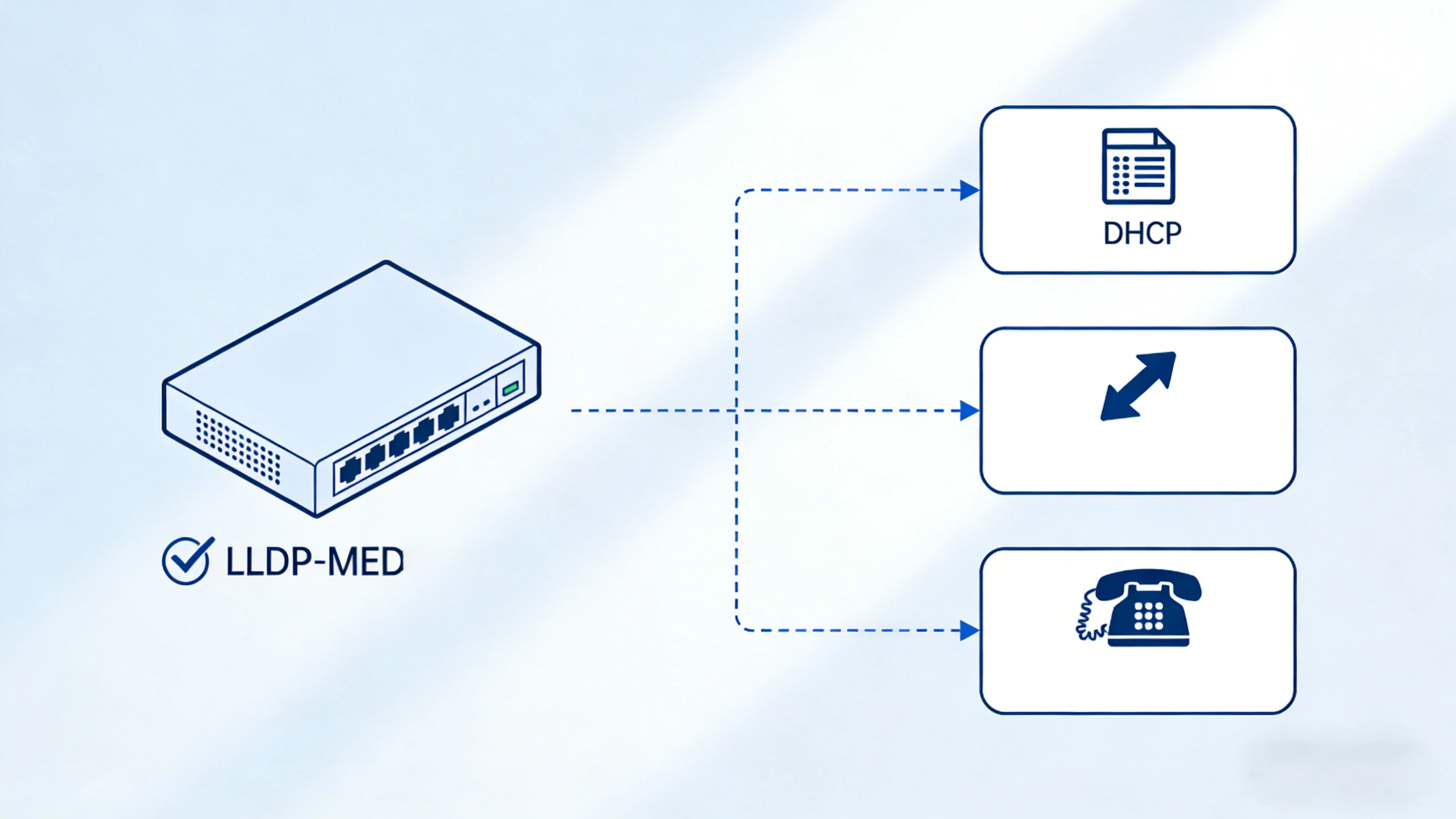
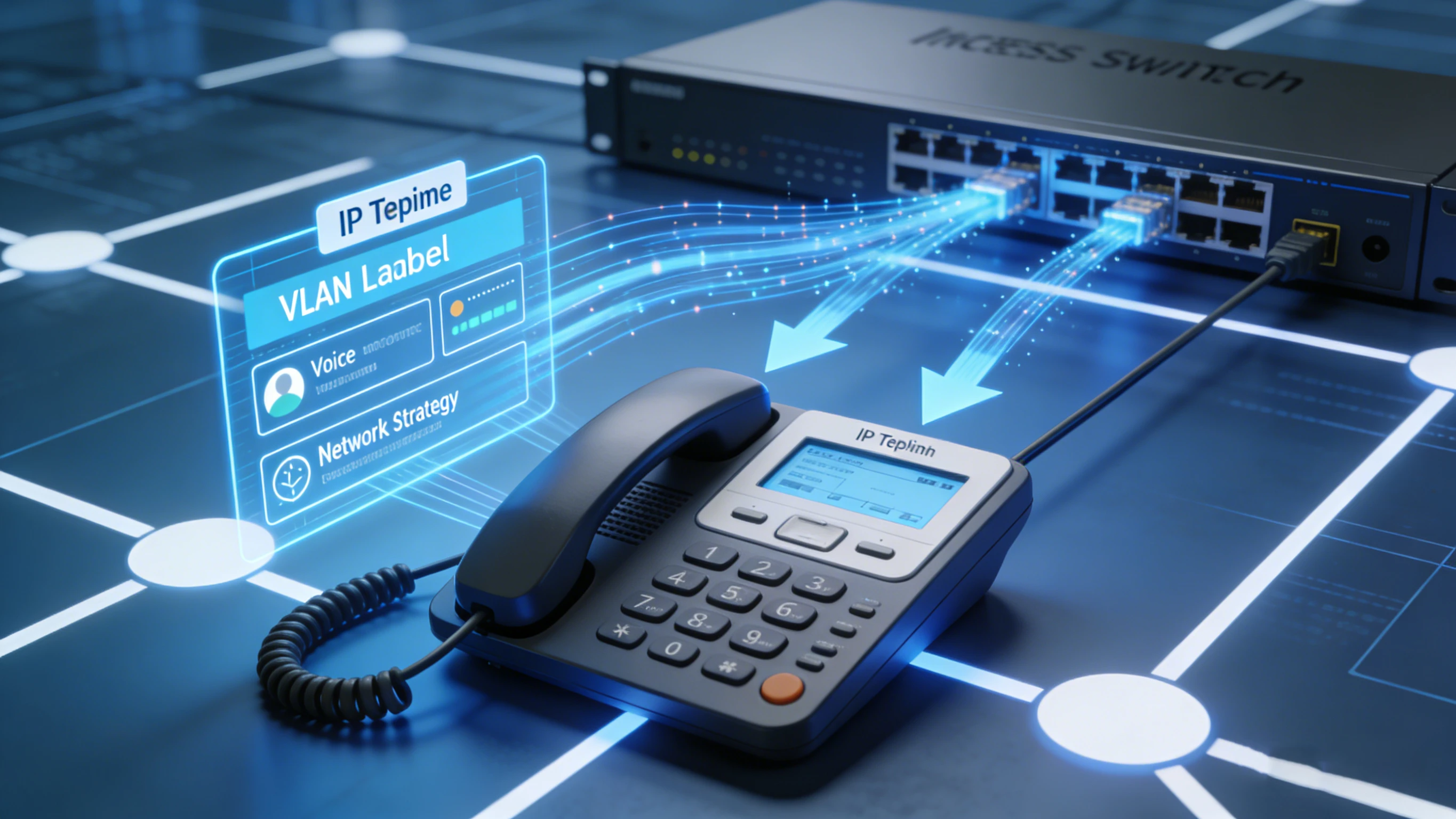
LLDP-MED operates between the endpoint and the network connectivity device, usually the IP phone and the access switch. After the Ethernet link comes up, the switch and endpoint exchange LLDP information. If the phone and switch support LLDP-MED, the exchange can include media-endpoint-specific TLVs that carry policy and operational details.
One of the most important elements is the network policy TLV. This can tell the phone which voice VLAN to use and what traffic priorities should apply. In a practical boot sequence, the phone may first come up on the native or untagged network, receive LLDP-MED policy from the switch, move to the advertised voice VLAN, obtain an IP address there, and then continue with DHCP and server discovery.
Other LLDP-MED information can include device capabilities, location identification, inventory data, and extended power information. Together, these items improve interoperability and reduce the amount of guesswork during deployment and troubleshooting.
Not by itself. This is the most important point to understand.
An IP phone usually needs much more than VLAN and QoS guidance. It still has to obtain an IP address, subnet mask, gateway, DNS information, NTP details, and one or more provisioning server addresses. Then it must download configuration files, check firmware, learn call-control settings, and register with the SIP platform or IP PBX.
That broader workflow is normally handled by a combination of technologies such as DHCP, vendor-specific DHCP options, TFTP, HTTP, HTTPS, TR-069 in some ecosystems, and the phone's own provisioning logic. LLDP-MED helps the phone get into the correct network context first. After that, the phone can reach the provisioning server and finish the job.
In daily engineering language, people often say a phone is auto-provisioned when it can be plugged in and brought online with little or no manual setup. LLDP-MED contributes to that experience, but it is only one piece of the chain.
A more accurate sequence looks like this:
So if someone asks whether LLDP-MED enables auto-provisioning, the best answer is yes, but indirectly. It improves and automates the network onboarding stage. The full provisioning result depends on the rest of the ecosystem being designed correctly.
This is the feature most administrators care about first. With LLDP-MED network policy, the switch can advertise the correct voice VLAN to the phone. That makes rollout faster, especially across large floors, campuses, warehouses, hospitals, transport hubs, and industrial sites where many endpoints are added or replaced over time.
Voice quality depends on more than just bandwidth. It also depends on traffic treatment. LLDP-MED can carry policy information related to traffic priority so the phone and switch behave more consistently. That does not replace end-to-end QoS design, but it makes access-layer policy more predictable.
In practical phone installations, power matters. Phones with color screens, expansion modules, Bluetooth, Wi-Fi, or video support may have different power needs than simpler desk phones. LLDP-MED works alongside the broader Ethernet and PoE environment to improve how the endpoint and switch exchange relevant capability information.
Asset visibility is often overlooked until support teams need it. Inventory information from the endpoint can make it easier to identify the connected phone model, software revision, and hardware details. That can simplify support, lifecycle planning, and replacement handling.
In some deployments, especially those with emergency calling or building-level response requirements, location information matters. LLDP-MED can help transport location-related data formats used in location-aware services and operational workflows.
Many engineers first encounter voice VLAN onboarding through Cisco Discovery Protocol, especially in legacy Cisco-centric environments. CDP can also provide voice VLAN information to phones, and in some Cisco deployments it remains widely used.
LLDP-MED, however, is the vendor-neutral option that helps mixed networks work more smoothly. In environments with third-party switches and third-party phones, LLDP-MED is often the more practical interoperability choice. The decision is therefore not only technical but also architectural: a single-vendor environment may tolerate proprietary discovery, while a multi-vendor estate benefits more from open standards.
These benefits are especially valuable when the organization manages many handsets, rotates desk locations frequently, or depends on predictable service quality across distributed branches.
In headquarters, branch offices, and shared workspaces, LLDP-MED helps desk phones join the proper voice network without manual endpoint edits.
Healthcare and education sites often have many access switches, segmented networks, and frequent endpoint changes. Standardized onboarding reduces operational friction.
In harsher or more distributed environments, fast replacement matters. When a phone fails, the new device can be connected and guided onto the correct network policy with fewer manual steps.
These environments often mix front-desk, back-office, service, and emergency communication endpoints. Consistent access policy helps control rollout quality.
Before relying on LLDP-MED, verify that both the switch and the phone support it and that the needed TLVs are enabled. Also confirm how the environment handles CDP, LLDP, and LLDP-MED priority if multiple mechanisms exist on the same estate.
Next, align the access layer with the provisioning layer. A phone placed into the correct voice VLAN still needs reachable DHCP services, the correct DHCP options or provisioning discovery method, time synchronization, and access to configuration and call-control servers.
Finally, test with real boot traces, not only configuration templates. In many deployment failures, LLDP-MED is working correctly but DHCP options, provisioning URLs, certificates, firewall rules, or PBX registration details are not.
If the phone lands on the right voice VLAN but still does not register, the problem is usually no longer LLDP-MED. It is typically DHCP, provisioning discovery, transport security, or SIP registration.
LLDP-MED is one of the most useful access-layer tools in modern IP telephony because it helps phones discover voice-specific network policy automatically. It reduces manual work, improves consistency, and supports cleaner interoperability in mixed-vendor voice environments.
Still, it should be described accurately. LLDP-MED is not the whole provisioning system. It is the early-stage discovery framework that helps the phone reach the right network conditions so the rest of the provisioning workflow can succeed. When combined with well-planned DHCP, provisioning servers, security settings, and PBX registration logic, it becomes a powerful part of practical zero-touch IP phone deployment.
No. LLDP is the base Layer 2 discovery protocol, while LLDP-MED is an extension aimed at media endpoint devices such as IP phones.
Yes, that is one of its best-known uses. The switch can advertise network policy so the phone learns which voice VLAN to use.
Usually not as the primary provisioning mechanism. Most phones still rely on DHCP options, vendor discovery methods, or provisioning platform logic to find their configuration server.
No. One of its main advantages is that it is designed for multi-vendor interoperability, unlike proprietary discovery protocols.
No. LLDP-MED and DHCP serve different roles. LLDP-MED helps with access-layer policy discovery, while DHCP provides IP configuration and often helps discover provisioning resources.