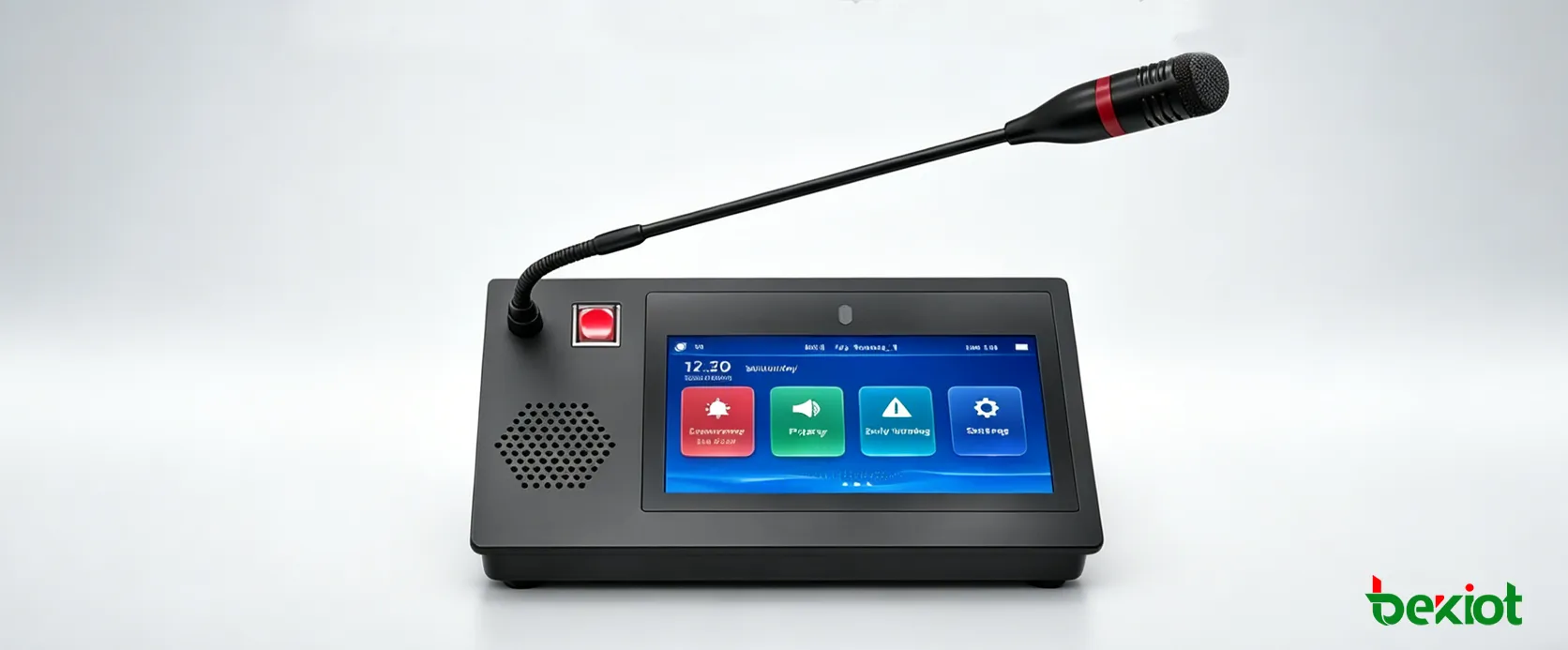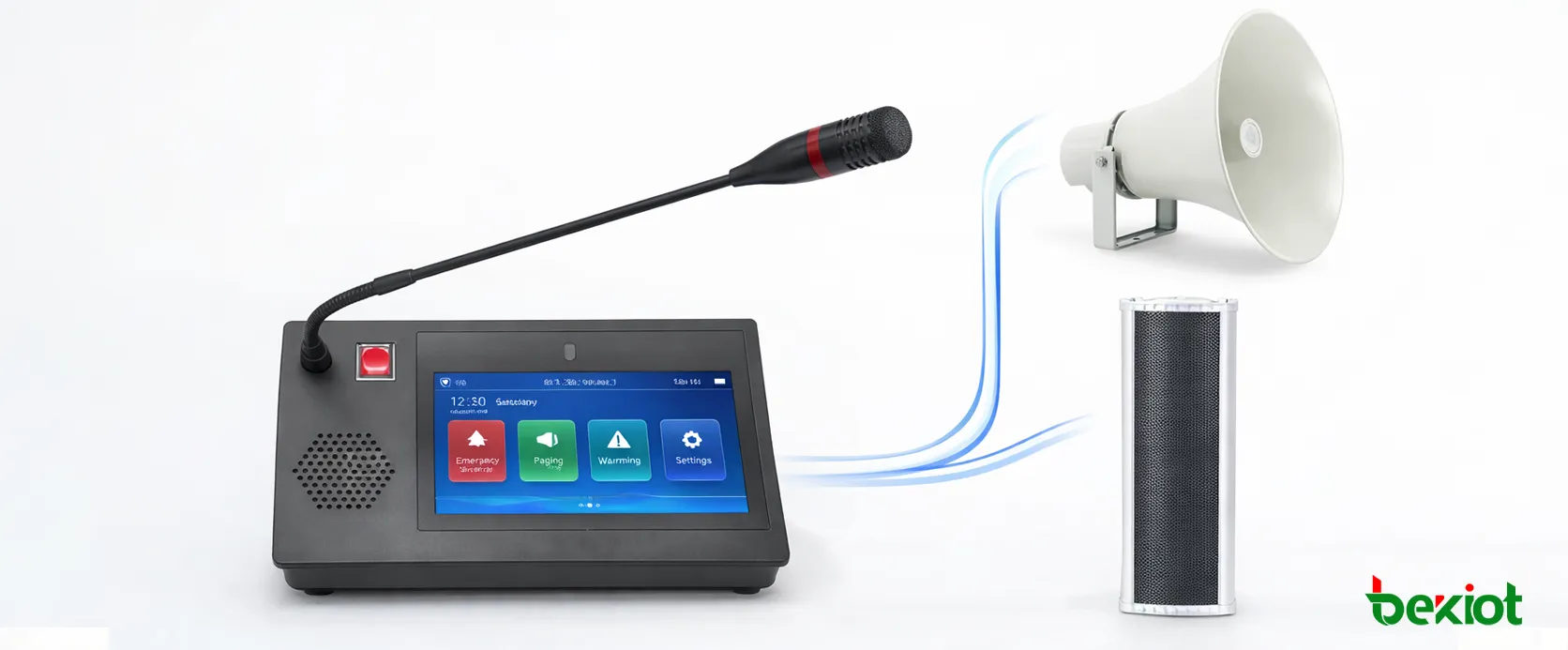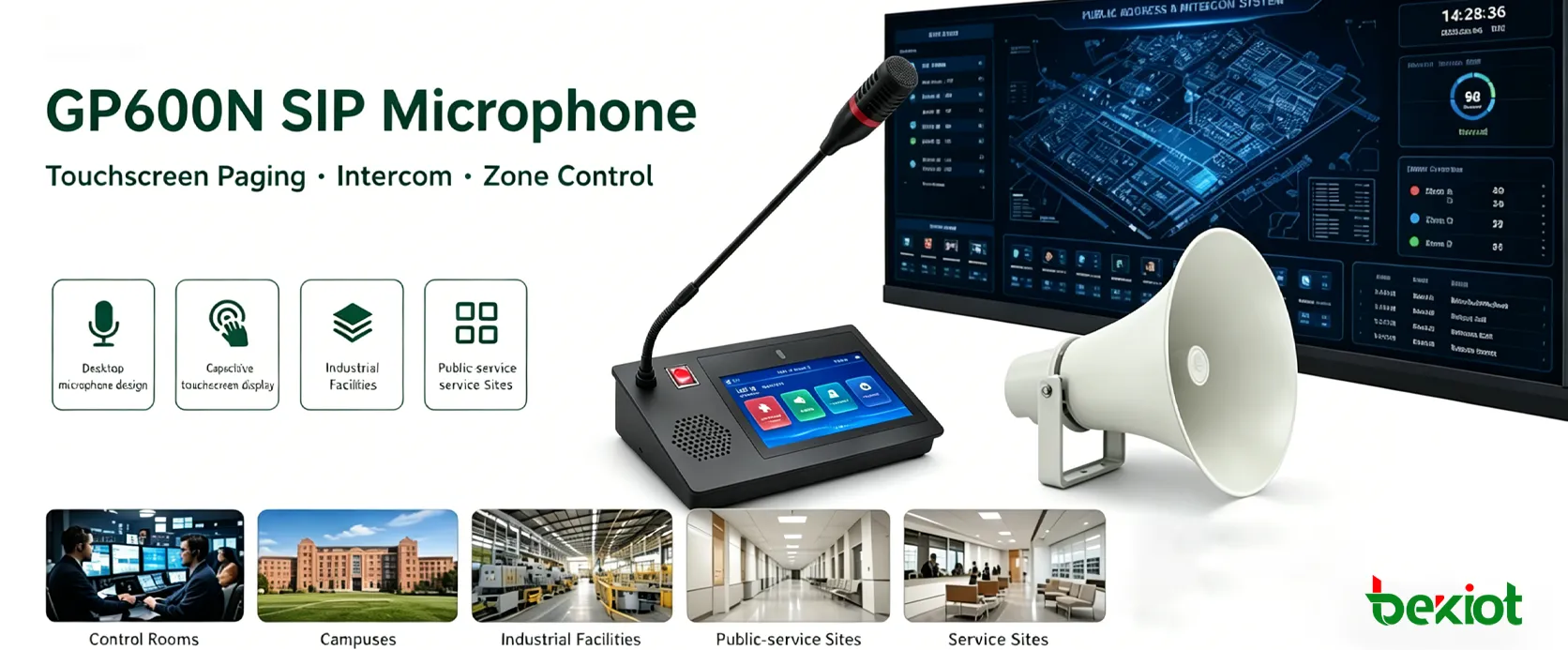
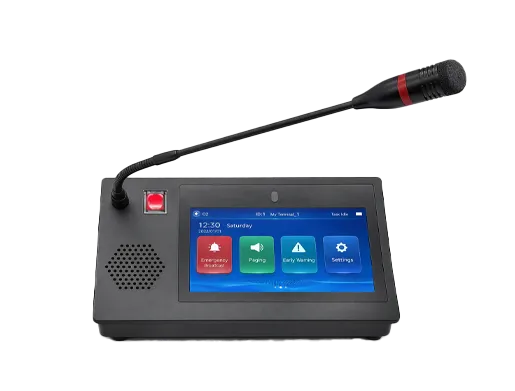
Becke GP600N is a higher-level SIP microphone terminal developed for projects that need more than standard desktop paging. With its 7-inch capacitive touchscreen, all-metal desktop structure, Linux-based platform, and strong local operating capability, it is designed for sites where broadcast control, intercom response, emergency action, and operational continuity all matter at the same time.
Instead of acting only as a simple paging microphone, GP600N is positioned as an interactive desktop command endpoint. It gives users a more visual and more efficient way to manage routine announcements, zone-based broadcasting, terminal selection, emergency paging, and voice intercom from one device. This makes it especially suitable for larger systems where operators need a microphone that can support both day-to-day communication and higher-priority event handling.
The product uses a desktop microphone design with an oxidized aluminum alloy panel and a full-metal base housing, giving it a more professional presence for control desks, reception points, school broadcast rooms, plant coordination stations, and security operation positions. For projects that want a SIP microphone with a stronger control role, GP600N provides a much more capable platform than a basic speaking-only terminal.

One of the clearest differences in GP600N is its 7-inch true-color capacitive touchscreen. The larger screen gives operators more room to view terminals, partitions, and function options, which is especially valuable in systems with more destinations, more zones, and more frequent broadcast activity. Instead of compressing information into a smaller control surface, GP600N makes interaction more direct and more comfortable for long-term daily use.
That larger interface improves workflow in practical ways. Operators can work more quickly when launching single-terminal calls, multi-terminal calls, single-zone broadcasts, multi-zone broadcasts, or full-zone announcements. It also makes the product better suited to sites where the paging microphone is not just an accessory but a real operating console at the desk.
A major strength of GP600N is its offline operating capability. The device can be configured to enable offline mode, allowing terminal information and scheduled tasks to be downloaded locally through the service software. Once that information has been stored on the microphone, the device can continue supporting broadcast paging, two-way intercom, and playback of downloaded scheduled tasks even when it is disconnected from the server.
This gives GP600N a very different value profile from ordinary SIP microphones. In many projects, continuity is just as important as features. Schools, factories, public facilities, and control rooms may still need essential voice communication even during network or server-side interruption. GP600N is built with that operational reality in mind, which makes it especially useful in deployments that care about resilience and not only convenience.
GP600N is designed not just for normal operation, but for communication continuity when conditions are less than ideal.
GP600N includes a red emergency button that can trigger one-touch full-zone broadcasting to authorized terminals. This is one of the most valuable product features for sites where urgent announcements must be launched immediately without menu navigation or workflow delay. In emergency or time-sensitive situations, reducing the number of actions required can make a meaningful difference in response speed.
This feature makes GP600N well suited to schools, industrial sites, transport facilities, and public buildings where the paging microphone may need to support both routine communication and higher-priority emergency notification. It gives the desktop unit a more serious operational role and makes it easier to position as part of an emergency communication strategy.
GP600N supports touch-based paging and broadcast calling with multiple target options. Operators can call a single terminal, multiple terminals, one partition, multiple partitions, or the full zone system from the device itself. This makes the microphone highly adaptable to different site structures, whether the deployment is organized by rooms, buildings, workshops, service areas, or campus sectors.
The practical value here is not just flexibility on paper. In real environments, staff often shift between narrow and broad communication tasks throughout the same day. One moment they may need to reach a specific point, and the next they may need to address a wider area. GP600N supports that range of use without making the operator leave the device or depend on a separate workstation for every action.
Beyond broadcasting, GP600N also supports fast initiation of two-way voice intercom with selected intercom terminals. The built-in 3W speaker enables direct two-way conversation, and the device supports switching between automatic answer and manual answer modes. This makes it practical not only for sending announcements but also for receiving and managing live voice communication as part of a wider system workflow.
That is particularly useful in environments where public announcements and person-to-person voice contact overlap. A control desk may need to announce, then confirm, then coordinate. GP600N supports that process from one device, helping reduce equipment switching and making operator action more efficient.
GP600N is built for responsive audio performance, with broadcast delay below 100 milliseconds. This helps maintain a more natural and immediate communication experience, especially in environments where speech timing matters. Whether the message is routine, instructional, or urgent, lower delay improves the operator’s sense of control and the listener’s experience of the system.
The microphone also supports line-in audio acquisition and USB drive broadcasting, giving it more flexibility than a live-speech-only device. This allows teams to play prepared content, scheduled messages, stored announcements, or externally sourced audio through the same desktop terminal. For many projects, this mixed usage model is important because broadcast systems are rarely limited to live talk only.

GP600N includes four customizable broadcast shortcut keys with user-defined names. By long-pressing a shortcut key, operators can quickly launch preset broadcast tasks. This is especially valuable in projects where the same announcements or zone-based actions are repeated throughout the day, such as shift notices, school bells, routine warnings, standard instructions, or service calls.
These shortcut keys help turn the device into a more workflow-oriented tool rather than just a reactive microphone. Users can move faster, reduce repeated steps, and keep routine communication more standardized across departments or shifts.
GP600N supports user permission configuration so that the microphone displays only the terminals and partitions within the user’s authorized scope. This capability is especially important in larger projects where different users or departments should not have access to the full system. It keeps the interface cleaner for everyday use and helps align the microphone with internal operating roles.
For multi-building campuses, factories with separate departments, hospitals with different control areas, or service networks with distributed responsibilities, this feature helps balance usability and control. Operators see what they need, and nothing more than they are supposed to manage.
GP600N also supports operation password verification and can be configured with a six-digit screen lock password. That makes it more suitable for shared desks, semi-public areas, and duty-based operating environments where access control matters. In addition, the device supports enabling or disabling broadcast prompt tones and allows users to define whether the paging microphone itself should receive broadcasts.
These may sound like small settings, but they make a real difference in deployment. They allow the microphone to be tuned more precisely to the logic of the site, whether the focus is quiet operation, role separation, or better handling of overlapping broadcast tasks.
From the maintenance side, GP600N supports browser-based access through its IP address for modifying network parameters, audio parameters, and configuration settings. The microphone software can also be updated through the browser interface. This simplifies installation support and long-term management, especially when multiple units are deployed across a single campus, facility, or regional network.
For installers and technical teams, this means the device is easier to maintain without relying only on local handling. For end users, it means the product remains practical not only at the time of deployment but throughout its lifecycle.
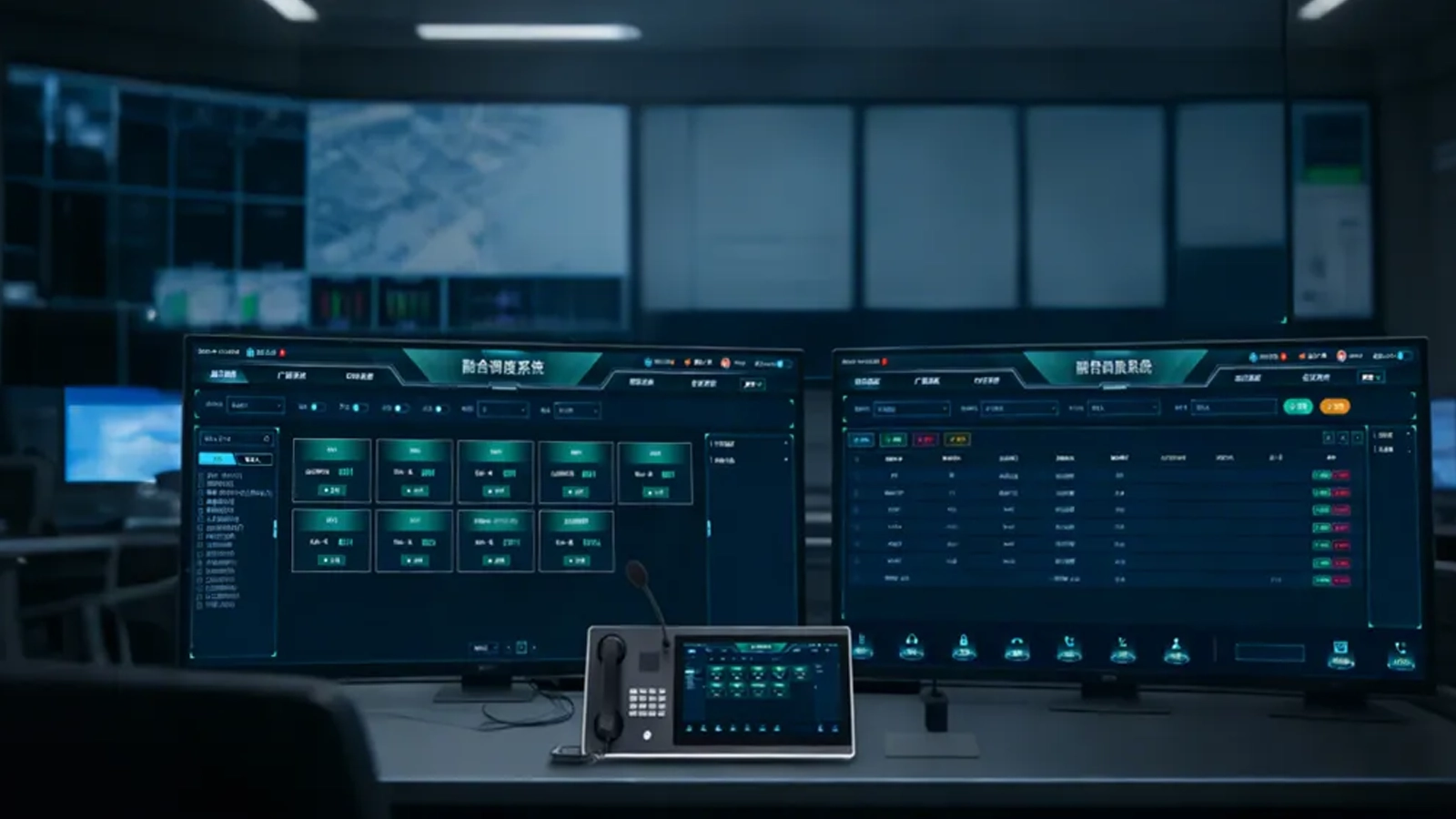
GP600N is particularly well suited to control rooms and command positions where the operator needs a desktop terminal with stronger visual interaction and more dependable local capability. The larger screen, partition handling, emergency trigger, intercom support, and offline mode all add value in these environments. The microphone can serve as a primary voice operating point for monitoring centers, dispatch rooms, facility control desks, and integrated communication workstations.
In these scenarios, the device is not simply used to speak into a system. It becomes part of the command workflow itself, supporting routine control and continuity under more demanding conditions.
For schools, colleges, and campus broadcast systems, GP600N offers strong value because it can support both scheduled and live communication in one touchscreen terminal. Staff can make routine announcements, address selected buildings or zones, initiate intercom communication, and even continue operating downloaded scheduled tasks in offline mode if needed. The emergency button also makes the product more suitable for campus safety-oriented communication design.
This gives education deployments a more complete desktop microphone solution for both daily administration and urgent response needs, especially in larger campuses with multiple functional areas.
Industrial projects often need clear area-based communication, rapid coordination, and greater operational resilience. GP600N fits well into production offices, dispatch rooms, warehouse management points, workshop coordination desks, and industrial park control centers where staff may need to switch quickly between live announcements, targeted paging, intercom follow-up, and prepared message playback.
The offline operating mode is especially meaningful here. In industrial environments, continuity of communication can remain important even when wider system conditions are degraded. GP600N gives these sites a stronger local voice control point that is not fully dependent on constant server availability.
GP600N also works well in hospitals, government buildings, visitor centers, service halls, and public facilities where staff need a professional desktop terminal for zone-based paging and direct voice contact with selected points. The larger touchscreen improves usability for front-line operators, while permission-based display helps match the device to departmental responsibilities.
In these settings, the product supports a cleaner balance between usability, control, and operational security. It is a better fit for sites that need more than a small paging microphone but do not want to depend entirely on a full PC interface for every broadcast action.

GP600N uses a desktop microphone structure with an oxidized aluminum alloy panel and full-metal base housing. It features a 7-inch capacitive touchscreen with 800×480 resolution or above, runs on a Linux-based platform, and supports one 10/100M RJ45 network port for LAN and internet access. It also provides line input, line output, short-circuit input, short-circuit output, and DC12V power input for practical system integration.
GP600N is a more advanced SIP microphone terminal for projects that need visual operation, emergency readiness, local task continuity, and stronger control over partitions and endpoints. Its value is not limited to the larger touchscreen. What really sets it apart is the combination of offline operating capability, one-touch emergency broadcasting, two-way intercom, permission-based display, browser-based maintenance, and flexible broadcast workflows.
For users building SIP-based paging and intercom systems in campuses, factories, control rooms, hospitals, and public facilities, GP600N offers a more resilient and more operationally complete desktop microphone solution. It is especially suitable where the microphone is expected to support both everyday voice management and mission-critical response tasks.
One of the biggest differences is offline mode. GP600N can download terminal information and scheduled tasks locally, allowing it to continue supporting broadcast, two-way intercom, and scheduled playback even when it is disconnected from the server.
Yes. It includes a red emergency button that can launch one-touch full-zone broadcasting to authorized terminals, making it suitable for urgent notification scenarios.
Yes. It supports touch-based broadcast calling to terminals and partitions, and it can also quickly initiate two-way voice intercom with selected intercom terminals using its built-in speaker.
GP600N is especially suitable for control rooms, campuses, factories, industrial parks, hospitals, and public-service facilities that need a touchscreen SIP microphone with stronger local control, emergency capability, and operational continuity.