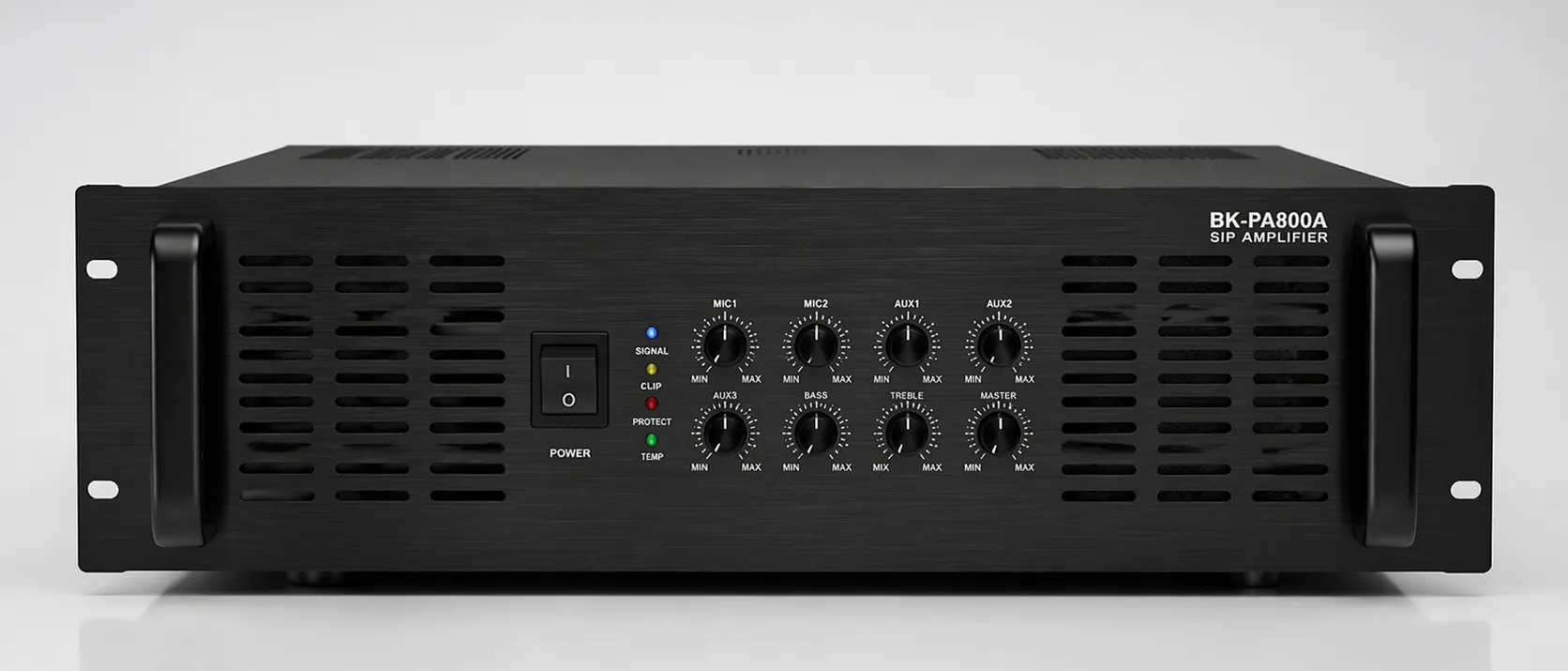
Becke BK-PA800A SIP Amplifier is built for large public address projects that require substantial output power, dependable network audio integration, and stronger field-level speaker driving capability. With a standard chassis design, 3U aluminum alloy front panel, and an internal high-power architecture optimized for demanding installations, it is positioned for projects where smaller amplifiers are no longer enough and where centralized broadcast control must extend into wider, louder, or more complex environments.
This model is designed for large campuses, industrial sites, logistics facilities, transport infrastructure, commercial complexes, and public-service buildings that need a practical combination of IP audio access, strong amplification, flexible local input, and reliable protection. By combining SIP-ready network decoding, WEB parameter management, 800W output power, independent channel adjustment, and support for both constant-voltage and low-impedance speaker connection, BK-PA800A offers a more deployment-ready solution for large-area paging and high-load public address systems.

BK-PA800A is positioned for projects that demand significantly more output reserve and speaker-driving capability than standard low- or medium-power SIP amplifiers. Its 800W output stage makes it suitable for large corridors, open halls, campus-wide zones, production workshops, warehouses, external coverage areas, and multi-zone facilities where clear announcements must remain effective even across demanding acoustic conditions.
This power level gives system designers more confidence when planning larger speaker loads, longer cable runs, or more extensive broadcast zones. Instead of building around multiple smaller units where one high-power amplifier is more practical, BK-PA800A provides a stronger centralized amplification option for large-area voice distribution.
BK-PA800A integrates a built-in IP audio decoding module and supports SIP, TCP/IP, UDP, and IGMP multicast protocols, allowing it to operate as part of a structured network audio architecture rather than as a standalone analog amplifier. It supports 16-bit stereo CD-quality network music and audio transmission, making it suitable for projects that need both spoken paging and general-purpose audio playback through an IP-managed system.
Its standard RJ45 network interface allows the device to be deployed anywhere Ethernet connectivity is available, and it supports cross-subnet and cross-router access. That gives installers greater flexibility when the amplifier needs to be integrated into larger managed networks or controlled from central servers and distributed IP systems across different buildings or zones.
In large public address projects, amplifier value is measured not only by wattage, but by how well power, network access, control flexibility, and operational protection come together in one system-ready platform.
The standard enclosure design and 3U aluminum alloy front panel make BK-PA800A suitable for professional cabinet deployment in equipment rooms, central broadcast racks, industrial control spaces, and integrated communication rooms. This helps create a more organized installation structure in projects where network devices, servers, audio controllers, and amplifiers are all assembled as part of a unified infrastructure.
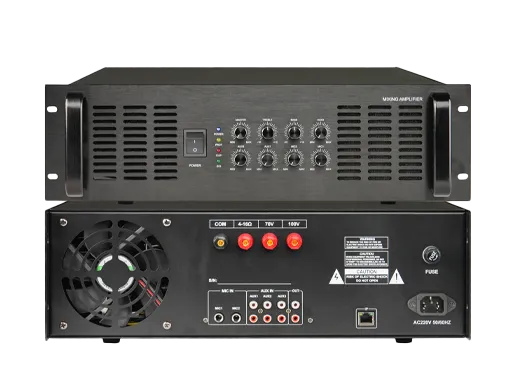
Its engineering-oriented format is supported by intelligent temperature detection and forced air cooling with low-noise fan design. The fan starts automatically when the internal power module reaches a specified temperature, helping maintain stable operation during higher-load conditions while supporting a more durable lifecycle in continuous-use environments.

BK-PA800A supports two RCA mixed outputs, two microphone inputs, and three line inputs, giving it the flexibility to work with live microphones, local playback devices, auxiliary audio sources, and network audio streams in one platform. Microphone 1 supports forced priority override and mute adjustment, which is useful when urgent voice announcements must interrupt background audio or lower-priority playback.
This structure makes the amplifier practical for day-to-day operations where audio control is not limited to one fixed source. It can support mixed broadcast workflows that combine central scheduling, live paging, local intervention, and distributed operational audio in larger facilities.
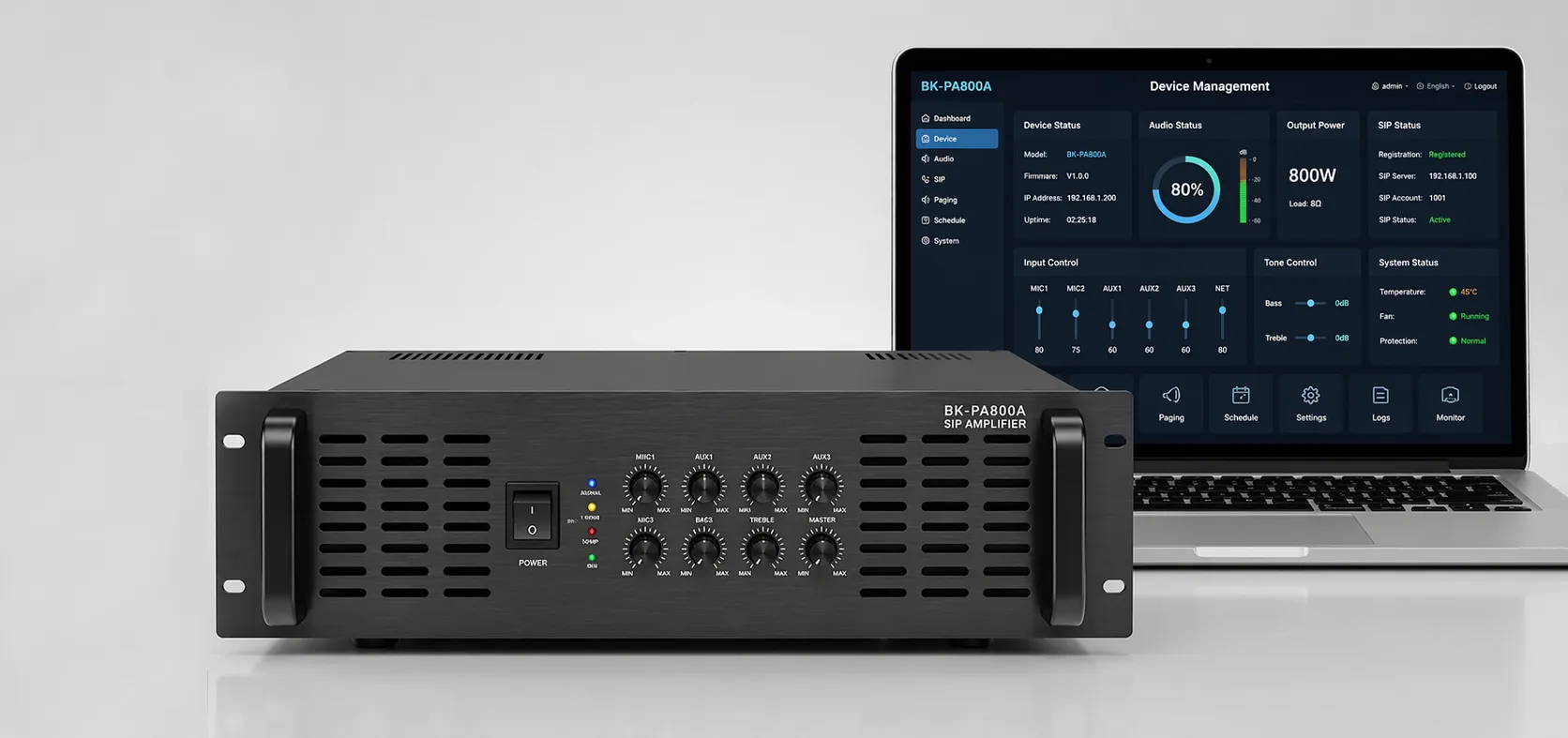
To improve deployment usability, BK-PA800A supports independent adjustment of network volume, bass, treble, and the volume of each input channel. This gives integrators and site operators more control over how the amplifier behaves in different applications, especially where multiple signal paths and different speaker areas must be balanced carefully.
Instead of forcing the same audio profile across every source, the amplifier allows more refined setup according to use case. A live microphone, an auxiliary playback source, and a network broadcast stream may all require different gain and tonal behavior, and BK-PA800A is designed to accommodate those differences more effectively.
BK-PA800A supports 100V and 70V constant-voltage output as well as 4Ω to 16Ω low-impedance output, making it easier to match the amplifier to a variety of speaker line architectures. This is especially important in large projects where outdoor horn speakers, corridor speakers, wall speakers, and other speaker types may exist in different areas or on different line structures.
For system designers, this flexibility reduces integration friction. It allows the amplifier to serve both distributed public address networks and more localized speaker circuits depending on project requirements, without limiting the design to a single output method.
BK-PA800A supports WEB login for viewing and modifying equipment parameters, which improves efficiency during commissioning, fault checking, and daily maintenance. In large installations where amplifiers may be deployed across multiple buildings or equipment rooms, browser-based management helps reduce manual servicing effort and supports a more centralized maintenance workflow.
Its network performance also supports practical deployment needs, including 10/100 Mbps transmission, adaptive audio bitrates from 8 Kbps to 320 Kbps, support for MP3 audio format, and sampling rates from 8 KHz to 48 KHz. Combined with low network latency performance, these features help the device integrate smoothly into modern IP paging environments.
BK-PA800A includes short-circuit, overcurrent, overload, overheating, and startup or shutdown impact protection, all supported by LED warning indication. It also provides saturation distortion warning and signal level indication LEDs, giving operators and maintenance personnel clearer visual feedback about output status and abnormal conditions.
These protection and monitoring features are especially valuable in high-power deployments. Large public address systems often run for long periods or face varied operating loads, and reliable amplifier protection is essential for maintaining uptime, protecting connected speakers, and improving confidence in long-term site operation.

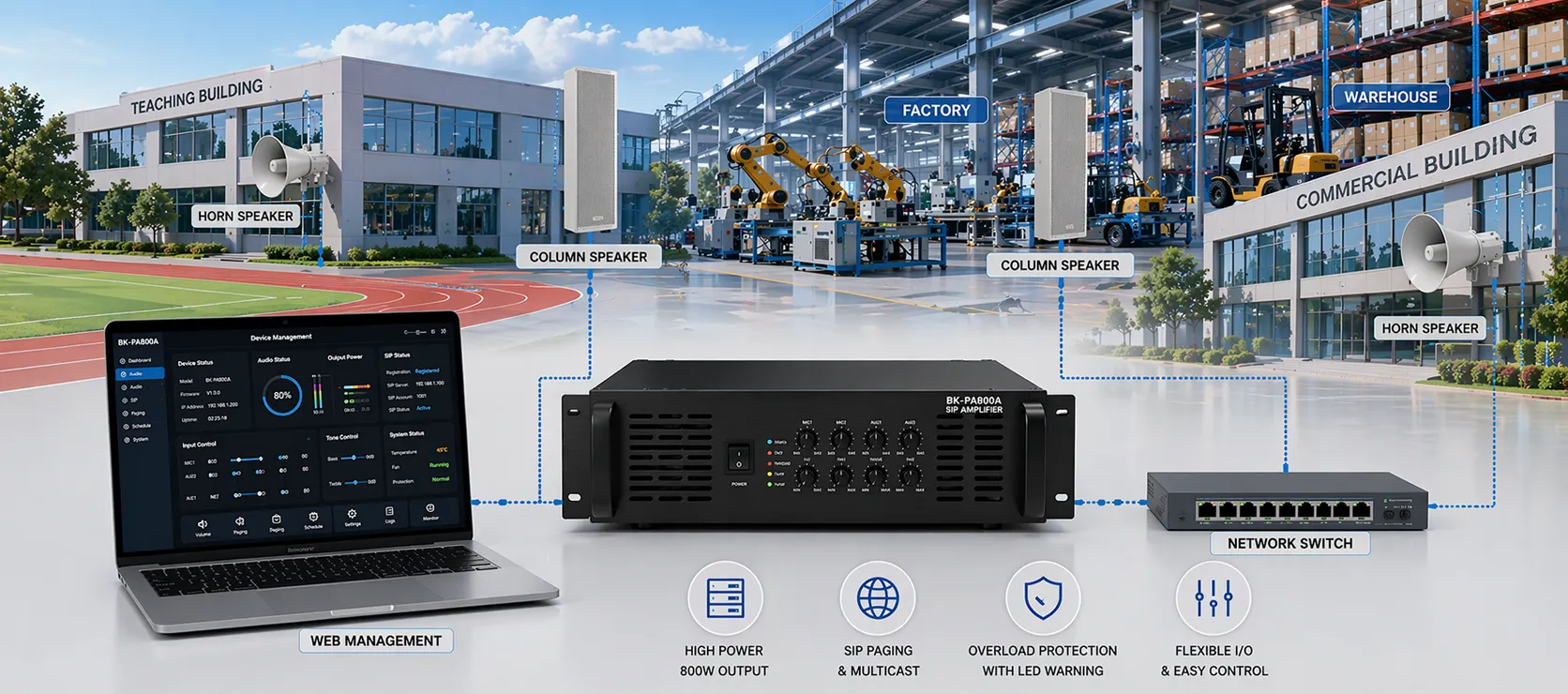
Education environments with multiple teaching buildings, dormitories, sports areas, open corridors, and public spaces often need stronger audio coverage than smaller amplifiers can provide. BK-PA800A is well suited for these scenarios because it can support larger speaker loads while still fitting into a network-managed broadcast system with WEB access and flexible source input.
Its ability to handle both routine program audio and live paging also makes it useful for campus announcements, class-change reminders, scheduled playback, emergency notice delivery, and wider-area voice distribution where central control and site-level flexibility must coexist.
Industrial facilities often present difficult acoustic environments and wide operational coverage requirements. Production workshops, logistics areas, loading zones, warehouses, utility buildings, and outdoor factory sections may all require higher power output to maintain usable speech intelligibility and reliable operational communication. BK-PA800A is positioned for these conditions with stronger speaker driving capability and more robust protection design.
Its support for local microphone priority, network playback, and independent audio adjustment makes it suitable for both routine production communication and urgent intervention. That makes it a practical fit for industrial users who need more than a basic background audio amplifier.
Commercial buildings, hospitals, transport terminals, retail properties, and mixed-use developments often require networked broadcast systems that can scale across larger floor areas and multiple zones. BK-PA800A can serve as a high-power SIP amplifier node in these projects, especially where broader coverage, more speaker circuits, or stronger amplification reserve is needed.
Because it supports different speaker output methods and cross-network deployment flexibility, it can be integrated into more complex facility audio planning with less compromise. This makes it suitable for integrators who need a more capable amplifier for medium-to-large IP paging projects.
Municipal buildings, transportation support sites, public service compounds, and infrastructure facilities often require robust broadcast equipment that can be managed centrally and operated reliably over long periods. BK-PA800A offers a strong fit for these environments by combining higher output power, network protocol compatibility, WEB management, and strong protection behavior in one rackmount device.
For these projects, the amplifier’s value comes from its ability to support broader coverage while remaining manageable as part of an IP-based audio architecture. It helps planners build systems that are not only louder, but also more structured, more maintainable, and easier to scale.
BK-PA800A stands out because it is engineered for large-scale paging and public address work rather than light-duty audio extension. Its 800W output, integrated SIP-ready decoding, flexible mixed inputs, independent parameter adjustment, cross-network access capability, WEB management, intelligent cooling, and layered protection design make it a more capable amplifier for projects with real coverage and load demands.
Compared with lower-power models, it is better suited to installations where output reserve, wider speaker distribution, and long-term operational stability matter most. For system integrators and project owners, BK-PA800A provides a strong balance of network audio compatibility, installation discipline, and high-power amplification performance.
BK-PA800A is best suited for large-scale SIP paging and public address projects in campuses, factories, warehouses, commercial buildings, transport facilities, and public-service environments where higher power output and broader speaker coverage are required.
Yes. It supports SIP, TCP/IP, UDP, and IGMP multicast, uses a standard RJ45 interface, and supports cross-subnet and cross-router deployment, making it suitable for integration into larger managed IP audio systems.
It supports 70V and 100V constant-voltage output as well as 4Ω to 16Ω low-impedance output, allowing it to adapt to a wide range of speaker line structures and project requirements.
Its reliability-focused features include intelligent temperature-controlled fan cooling, short-circuit protection, overcurrent protection, overload protection, overheating protection, startup and shutdown impact protection, distortion warning, and LED status indication for clearer monitoring and maintenance.