
IndustryInsights
In hazardous industrial environments, communication equipment is more than an operational tool. It is part of the safety infrastructure that supports daily coordination, emergency reporting, and rapid incident response. In places where flammable gas, combustible vapor, or explosive dust may be present, a conventional telephone is not suitable because even a small spark or excessive surface temperature may introduce unacceptable risk.
An explosion-proof telephone is designed specifically for these demanding conditions. The right model helps maintain reliable voice communication while meeting the certification, enclosure, and durability requirements of the site. This guide explains the key factors to evaluate before selecting an explosion-proof telephone for refineries, petrochemical plants, offshore platforms, mines, power facilities, and other hazardous areas.
The most important rule is simple: the telephone must match the hazard level of the installation area, not just the communication preference of the project team.
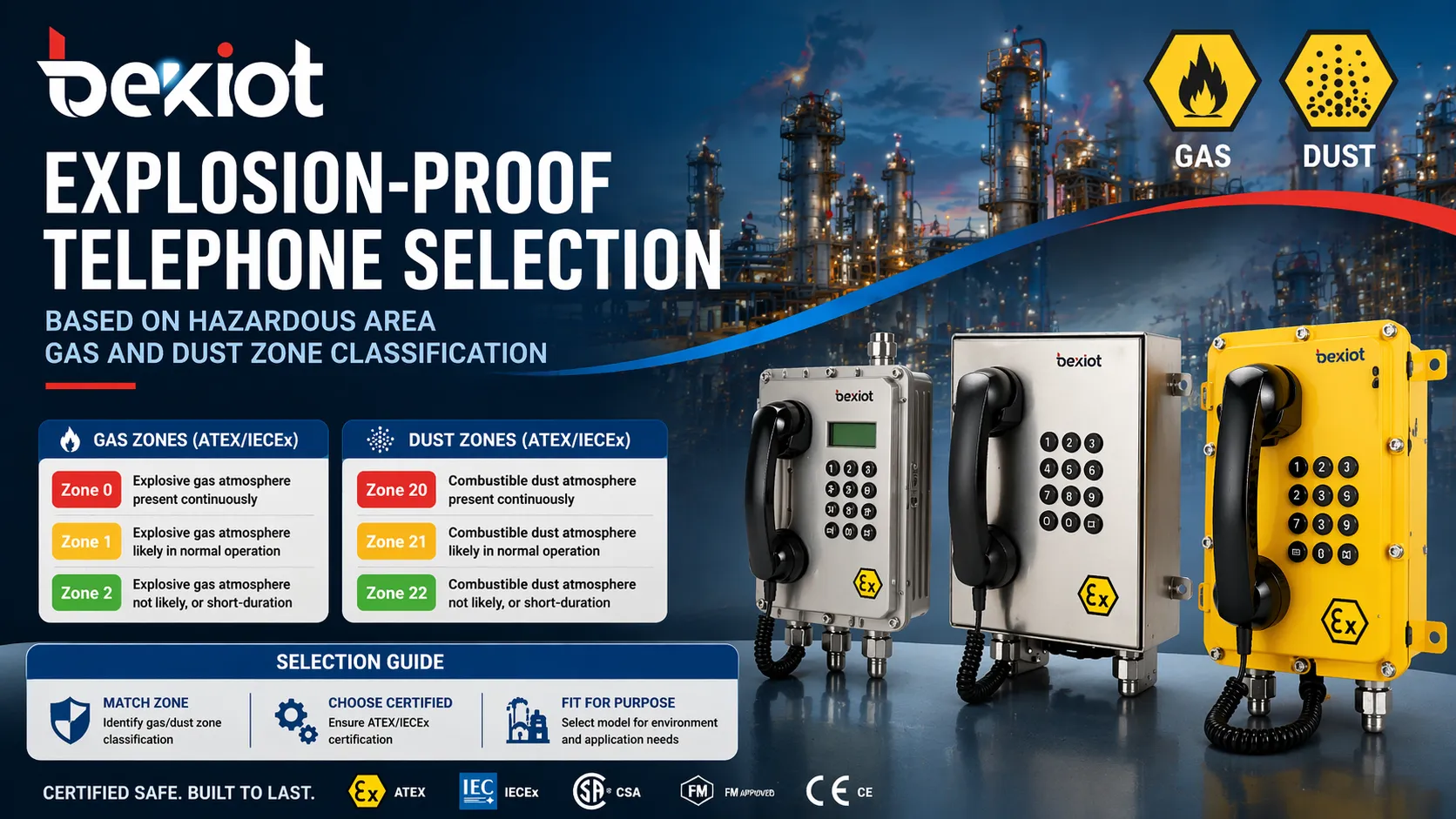
The first and most important step is understanding the hazardous area classification of the installation point. This determines what type of certified equipment can be used. In hazardous industries, the atmosphere may contain flammable gas, vapor, mist, or combustible dust, and each type of risk is categorized differently. If the classification is not clearly defined before procurement, the project may end up with equipment that cannot legally or safely be installed.
For gas and vapor environments, the IEC zone system commonly uses Zone 0, Zone 1, and Zone 2. Zone 0 refers to areas where explosive gas atmospheres are present continuously or for long periods, while Zone 1 indicates that explosive gas atmospheres are likely to occur during normal operation. Zone 2 refers to places where explosive gas is not likely to occur in normal operation, and if it does appear, it is only present for a short duration. Dust environments are similarly classified as Zone 20, Zone 21, and Zone 22.
Once the zone is confirmed, the explosion-proof telephone must be selected with a certification level that matches or exceeds the site requirement. This is not an area for approximation. A telephone approved for Zone 1 can typically be installed in Zone 2, but a Zone 2 device should not be installed in a Zone 1 location. The same logic applies to dust-classified areas.
This is why coordination with site safety engineers and compliance teams is essential before final model selection. The correct zone rating affects not only the housing design, but also component sealing, cable entry structure, operating temperature range, and approval markings on the device nameplate. The hazard classification is the foundation of every other purchasing decision.

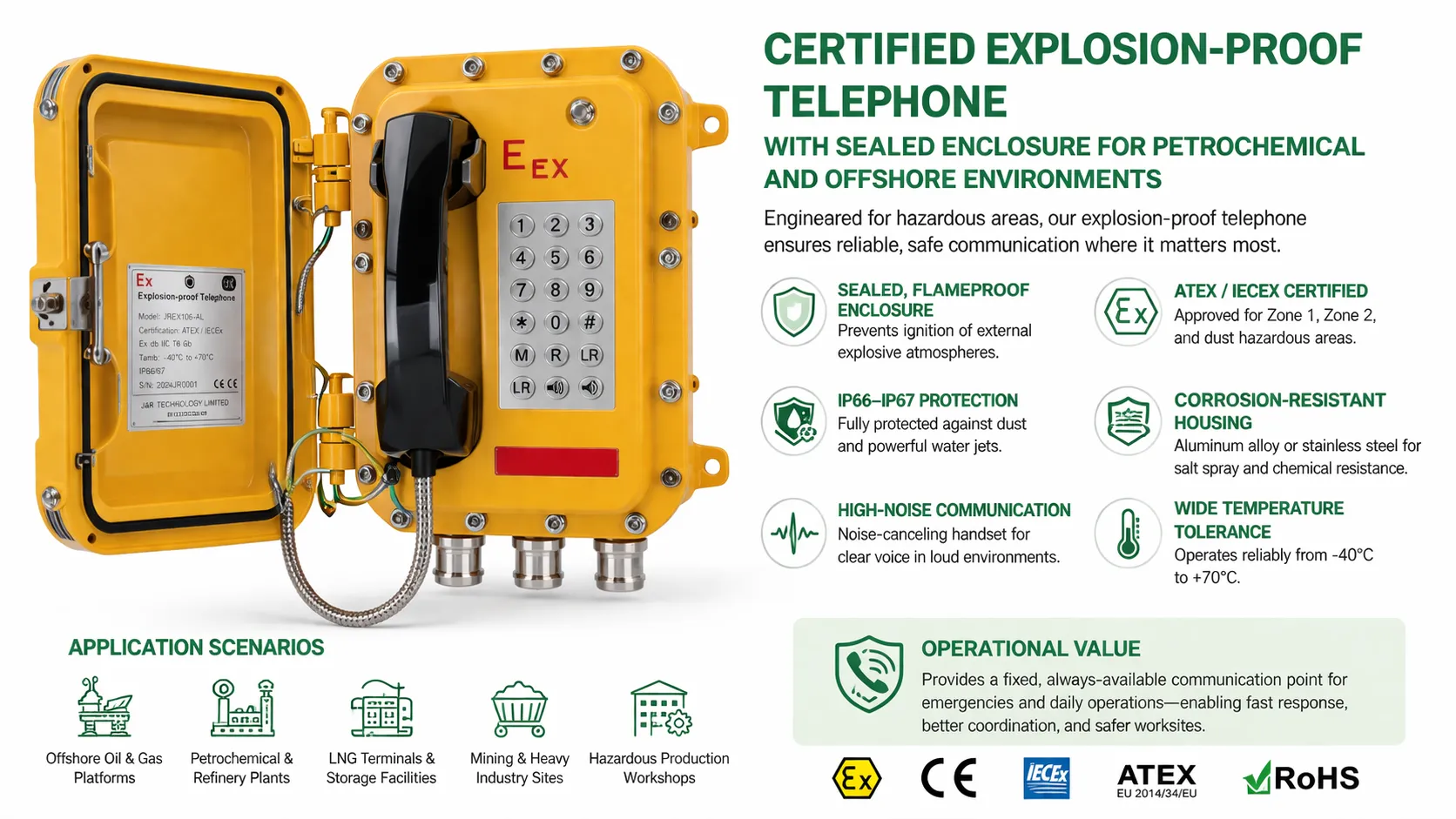
A rugged housing alone does not make a product suitable for hazardous areas. The telephone must carry recognized explosion-proof certifications issued for the target market and application. In Europe and many international projects, ATEX and IECEx are the most widely referenced certification systems. In North America, projects may instead rely on Class and Division approvals under UL or CSA frameworks.
These certifications indicate that the product has been designed and tested for use in explosive atmospheres under defined conditions. When reviewing a product, the certification label, marked protection concept, temperature class, ambient range, and application scope should all be checked carefully. Procurement teams should always confirm that the certification is valid for the specific project region and hazard type rather than assuming that one approval automatically covers all use cases.
Hazardous areas are often harsh in more ways than one. The telephone may also be exposed to rain, washdown, corrosive vapor, airborne dust, salt spray, UV radiation, or heavy temperature swings. That is why ingress protection is a critical secondary requirement. In many industrial applications, an enclosure rated IP66 or higher is preferred because it offers strong protection against dust entry and water jets.
For offshore, coastal, mining, and chemical processing applications, environmental resistance has a major effect on long-term performance. A certified unit that cannot withstand corrosion, vibration, and exposure conditions will create maintenance problems and shorten service life. A robust explosion-proof telephone should therefore combine hazardous-area compliance with a high-quality weather-resistant enclosure.

The enclosure material has a direct impact on durability, corrosion resistance, and service life. High-quality explosion-proof telephones are commonly made from materials such as glass reinforced polyester, die-cast aluminum alloy, or stainless steel. The right material depends on where the phone will be installed and what it will be exposed to over time.
In chemical plants and offshore platforms, corrosion resistance is especially important. In mining or heavy manufacturing, impact resistance and structural strength may be the larger priority. A telephone intended for long-term industrial deployment should also feature durable seals, protected cable entries, an armored handset cord where appropriate, and fastening structures that remain stable under vibration and repeated use.
In a real incident, workers may need to find the telephone quickly under stress, in poor lighting, or while wearing gloves and personal protective equipment. This makes visibility an important design consideration. High-visibility colors such as safety yellow or orange can help the unit stand out from surrounding equipment, walls, and pipework.
The user interface should also be practical for industrial conditions. Large keys, glove-friendly buttons, clear labeling, a protected handset, and a durable cradle all improve usability. A well-designed explosion-proof telephone is not just compliant on paper. It is easy to locate, easy to use, and dependable when personnel need it most.
In hazardous areas, the best telephone is not the one with the longest specification sheet. It is the one that remains easy to find, easy to operate, and easy to trust during an emergency.
Analog explosion-proof telephones remain relevant in many industrial projects, especially where legacy wiring and existing PBX infrastructure are already in place. They can be a practical option for facilities that want straightforward voice communication without broader IP integration. In retrofit scenarios, analog models may reduce installation complexity because they align with established copper-based infrastructure.
Analog telephones are often valued for their simplicity and familiarity. For some facilities, especially those with stable legacy systems and limited requirements for centralized software management, they provide a reliable and cost-effective path. The right choice depends on how much the site values modernization, integration, and future expansion.
For new projects and digital upgrades, SIP-based explosion-proof telephones are often the stronger long-term choice. A SIP model can integrate with modern IP PBX platforms, dispatch systems, emergency communication networks, and broader industrial communication architecture. This makes it easier to scale the system and connect voice communications with monitoring, paging, recording, and centralized management tools.
Many SIP models also support Power over Ethernet, which allows a single network cable to carry both data and power. This can simplify installation and reduce infrastructure complexity in certain deployments. In addition, SIP architecture generally supports more flexible configuration, better interoperability with modern platforms, and easier remote diagnostics for maintenance teams.
In refineries, compressor stations, process plants, and mines, ambient noise can be severe. A telephone that works well in a quiet office may be almost useless in these conditions. Strong acoustic design is therefore essential. Industrial telephones should provide clear audio output, robust microphones, and echo or noise control features that help operators understand the caller despite the background noise.
For especially noisy locations, the quality of the handset, microphone isolation, speaker performance, and enclosure acoustics all become important. The goal is not only for the call to connect, but for both sides to communicate clearly enough to exchange instructions, describe the incident, and confirm actions without confusion.
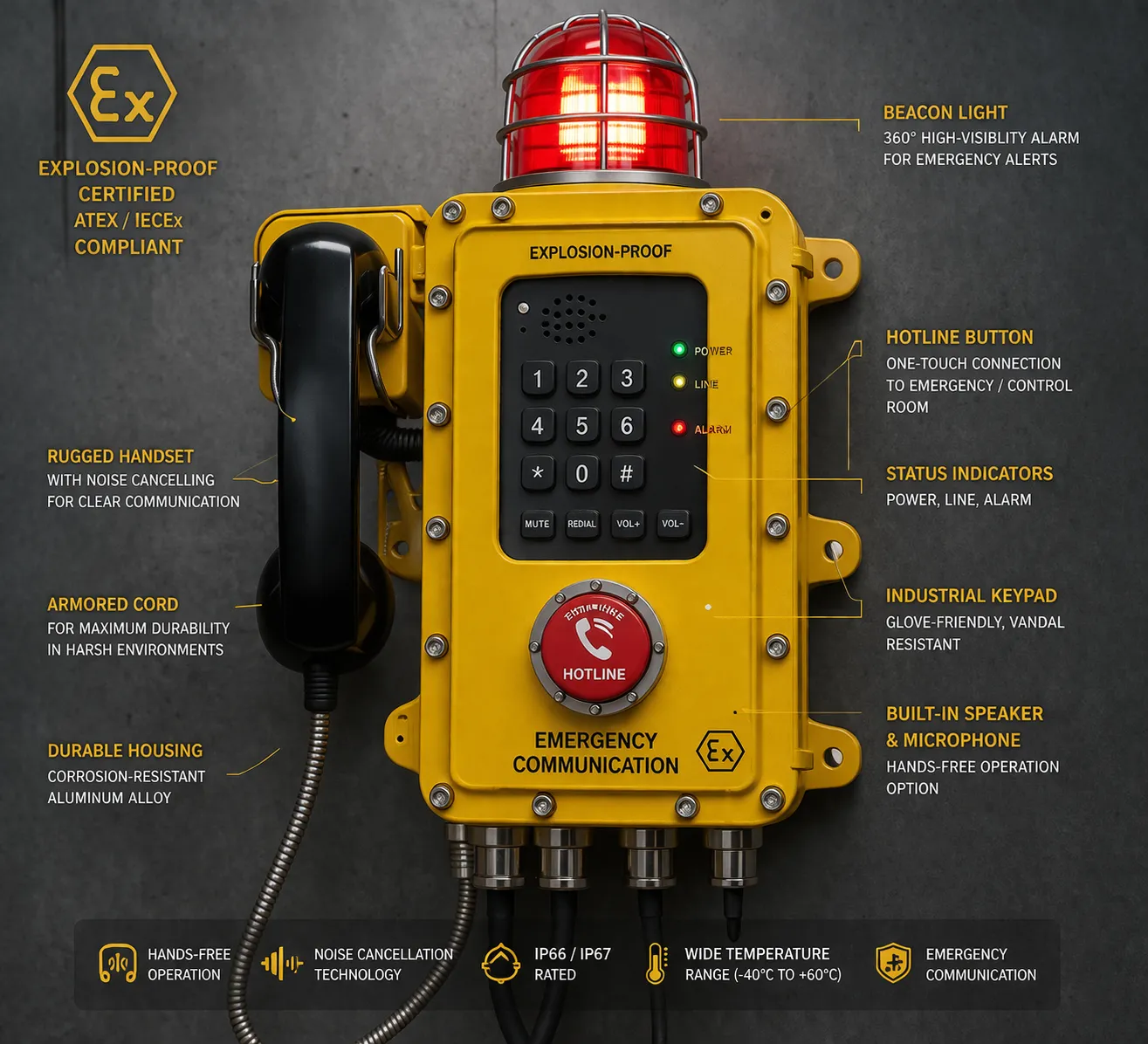
During an emergency, workers should not need to navigate a complicated interface. One-touch hotline buttons, auto-dial capability, and dedicated SOS keys can help personnel connect to a control room or security desk immediately. In some environments, this can reduce response time and lower the chance of dialing errors when users are under pressure.
Visual and audible call indicators are also valuable. A high-output ringer and integrated beacon or strobe can make incoming calls noticeable even in loud or visually complex environments. Backlit keypads, glove-friendly buttons, and large operating surfaces further improve usability during night shifts, shutdowns, and emergency scenarios.

Maintaining equipment in hazardous areas is costly because site access is restricted and intervention may require permits, shutdown coordination, and qualified personnel. For this reason, product reliability over time is a major purchasing factor. A cheaper device that fails more often can become far more expensive over its operating life than a higher-quality model with better durability and easier serviceability.
Well-designed explosion-proof telephones often include ruggedized components, replaceable high-wear parts, and mechanical structures intended for long-term industrial use. Features such as protected wiring, durable hookswitch assemblies, sealed enclosures, and robust cords all contribute to lower lifecycle risk.
Modern industrial communication projects increasingly value proactive maintenance. SIP-based explosion-proof telephones may support status reporting, remote configuration, or centralized monitoring through the communication platform. This can help maintenance teams identify offline devices, fault conditions, or service interruptions earlier, instead of discovering them only after a failed emergency call.
Lifecycle value also includes future compatibility. Facilities evolve, control rooms are modernized, and communication systems are expanded. A telephone that fits into a broader open communication architecture can help protect the investment over the long term. This is especially important for large industrial operators managing multiple sites or phased modernization programs.
| Parameter | What to Confirm |
|---|---|
| Hazard Classification | Confirm whether the installation area is Zone 1, Zone 2, Zone 21, Zone 22, or another applicable classification. |
| Certification | Check for ATEX, IECEx, UL, CSA, or other required approvals based on project location and compliance requirements. |
| Ingress Protection | Specify the required IP rating for dust, water, washdown, or marine exposure. |
| Communication Protocol | Decide whether the project requires analog integration, SIP/VoIP deployment, or migration compatibility. |
| Environmental Conditions | Review temperature range, corrosion exposure, UV conditions, vibration level, and installation method. |
| Emergency Functions | Identify whether hotline dialing, beacon light, high-noise audio, backlit keypad, or hands-free calling is required. |
| Maintenance Strategy | Evaluate replaceable parts, remote monitoring support, and long-term service availability. |
Selecting the right explosion-proof telephone is a safety-driven engineering decision. The best choice is the one that aligns with the site’s hazardous area classification, regulatory requirements, communication architecture, and real operating conditions. Certification, enclosure strength, audio clarity, emergency usability, and lifecycle reliability all matter, and they should be evaluated together rather than in isolation.
When the goal is dependable communication in hazardous areas, the selection process should always prioritize compliance and long-term performance over initial purchase price alone. A properly chosen explosion-proof telephone supports both operational continuity and emergency readiness, which makes it a critical part of industrial safety infrastructure.
If you are planning a refinery, petrochemical, offshore, mining, or industrial safety communication project, Becke Telcom can help you evaluate suitable explosion-proof telephone options based on zone classification, deployment method, and system integration requirements.
A rugged telephone is built to resist harsh physical conditions such as dust, water, impact, or outdoor weather. An explosion-proof telephone goes further by being specifically designed and certified for use in hazardous areas where explosive gas or dust may be present. A rugged housing alone is not enough for hazardous-area compliance.
No. The device must be approved for the hazard level of the installation area. A telephone certified only for Zone 2 should not be installed in Zone 1. The certification level must match or exceed the site requirement.
For new projects, SIP is often preferred because it supports modern IP infrastructure, centralized management, and broader integration with dispatch or communication platforms. Analog may still be suitable where legacy PBX systems and copper infrastructure are already established and remain part of the long-term plan.
The required rating depends on the environment, but many industrial projects prefer at least IP66 for strong dust and water protection. Sites with heavy washdown, outdoor exposure, or severe environmental conditions may require even higher enclosure performance.
These features improve emergency usability. A hotline or SOS button helps users connect quickly without dialing, while a beacon or strobe provides a visible alert in noisy or visually complex industrial environments. Together, they can improve response speed and communication effectiveness.