资源简介
 Encyclopedia

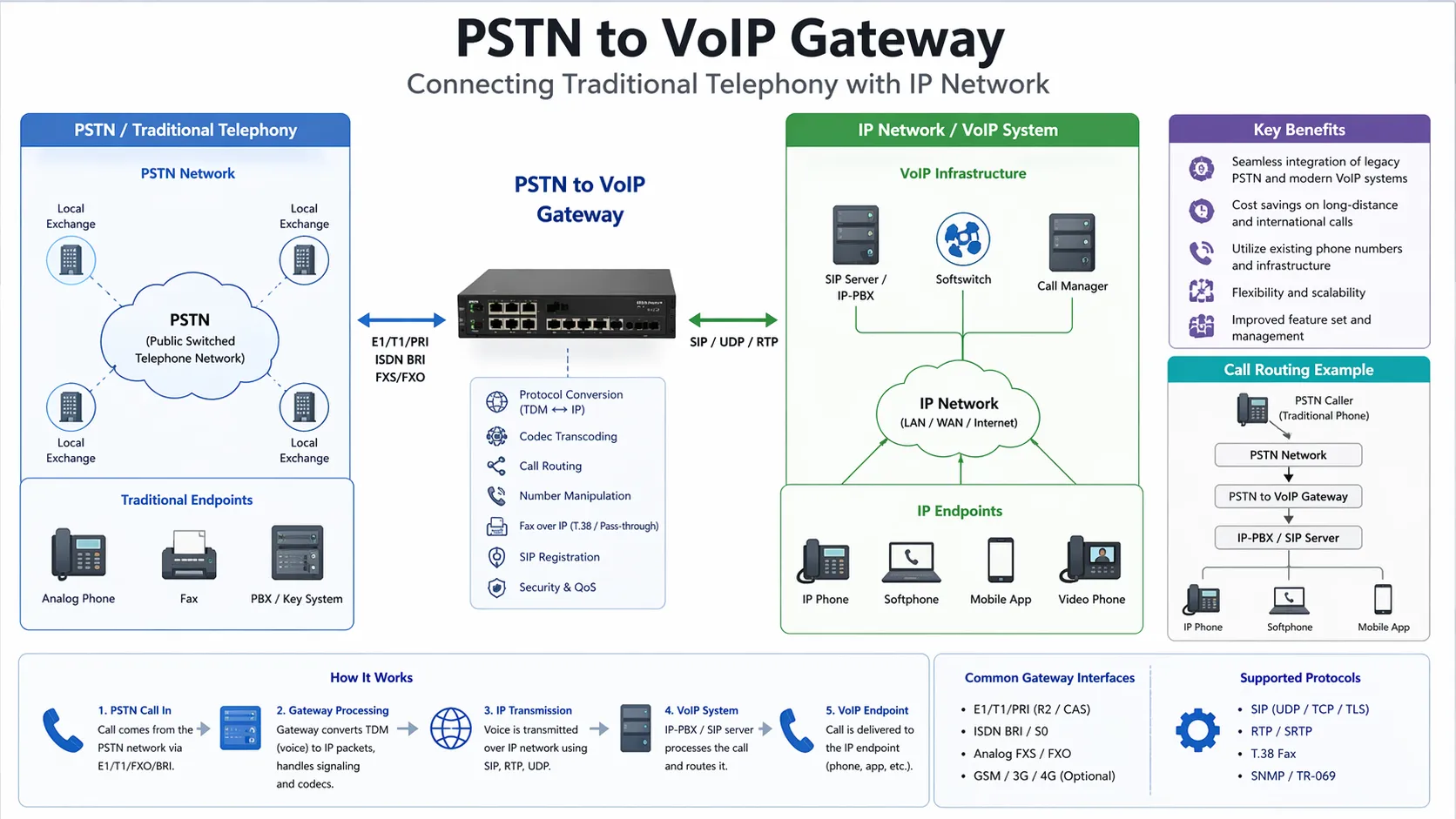
The Public Switched Telephone Network (PSTN) is the traditional global telephone system that enables voice communication through circuit-switched networks. It includes copper wires, fiber optic cables, switching centers, and satellite links.
For decades, PSTN has served as the backbone of global telecommunications, supporting landline services and forming the foundation for many modern communication systems.
PSTN originally relied on analog transmission but has evolved to incorporate digital switching technologies. Despite the rapid growth of IP-based communication, PSTN continues to play a vital role worldwide.
Today, it often operates alongside VoIP and SIP-based systems, enabling seamless communication between traditional and modern infrastructures.
PSTN continues to bridge legacy telephony and modern IP communication, ensuring compatibility and reliability across networks.
PSTN operates using circuit switching, where a dedicated communication path is established between two endpoints for the duration of a call.
This method ensures stable and consistent voice quality, although it may be less efficient than packet-based communication systems.
The PSTN infrastructure includes local loops, central offices, trunk lines, and switching systems. These elements work together to route calls across local, national, and international networks.
Signals may be transmitted in analog or digital form depending on the specific segment of the network.
Modern communication systems integrate PSTN with VoIP networks using gateways that convert analog signals into digital packets.
Protocols such as SIP enable interoperability, allowing organizations to combine traditional telephony with advanced IP-based communication features.

PSTN is widely used for landline telephone services in both residential and business environments, providing reliable voice communication without internet dependency.
Many organizations use PSTN as a backup system in case of IP network failures or outages.
Businesses often connect PSTN to IP PBX systems to enable external calling and hybrid communication environments.

Organizations rely on PSTN for external voice communication.
PSTN plays a crucial role in emergency communication systems.
In remote areas, PSTN may still be the primary communication infrastructure.

Yes, especially as backup.
PSTN uses circuit switching, VoIP uses packet switching.
Yes, via gateways and SIP.
底部简介