Effective communication is crucial during emergency situations. When disasters strike – whether natural (earthquakes, floods, hurricanes) or man-made (industrial accidents, terrorist attacks) – reliable communication links enable first responders, emergency managers, and affected communities to coordinate response efforts, share critical information, and ensure public safety. This report provides a comprehensive overview of an emergency response communication solution, including the technical requirements, available communication techniques and systems, software and digital tools, architectural considerations, and case studies of real-world deployments.
Emergency communication systems must meet several stringent requirements to function under challenging conditions:
Meeting these requirements often involves a combination of different communication technologies working in tandem – a hybrid approach that leverages the strengths of each solution.
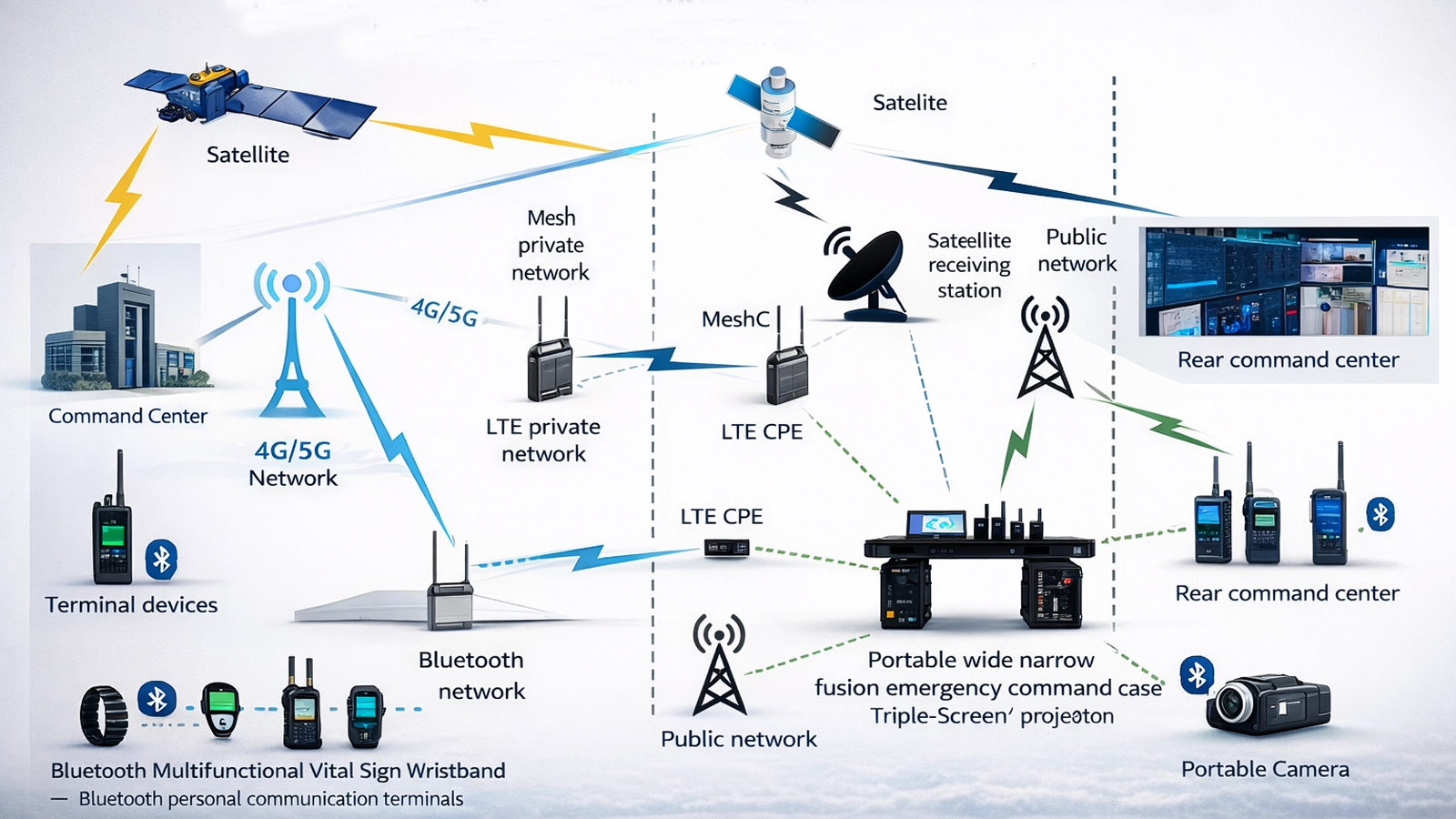
Emergency response communications rely on a variety of techniques and systems, including wireless mesh networks, cellular networks, satellite communications, radio systems, and public alerting systems. Below we discuss each of these in detail:
Overview: A wireless mesh network (WMN) is a decentralized network of wireless nodes (routers, access points) that relay data between each other. In an emergency, mesh networks can be deployed quickly to provide local connectivity when traditional wired networks are unavailable. Each mesh node acts as both a client and a router, forwarding traffic to other nodes until it reaches a gateway to the broader network.
How It Works: Nodes in a mesh network form a peer-to-peer network. If one node’s signal is blocked, traffic can route through other nodes, creating a resilient “multi-hop” path. This redundancy makes mesh networks highly robust against single-point failures. In emergency scenarios, responders can deploy mesh routers or even smartphones running mesh software to create a temporary network that spans a disaster area.
Use Cases: Wireless mesh has been used in several disaster response efforts. For example, after Hurricane Sandy in 2012, emergency responders set up wireless mesh networks to provide internet access to first responders in the field. Mesh networks have also been used in wildfire and earthquake response to connect firefighters’ devices and provide local communication hubs. One advantage is that mesh networks can be deployed quickly – often in under an hour – and can cover large areas without the need for infrastructure like fiber or towers.
Advantages:
Limitations:

Overview: Cellular networks (especially 4G LTE and newer 5G) are the backbone of modern emergency communications for the public and first responders. These networks are widely available in urban and rural areas and provide high-speed data, voice, and text services. First responders often rely on cellular networks to coordinate with dispatch centers, share location data, and access databases. In many countries, dedicated emergency networks (such as FirstNet in the US or dedicated bands in other countries) are being deployed to ensure priority access for responders during emergencies.
Use Cases: During a disaster, first responders use their smartphones and tablets on the cellular network to communicate with command centers and each other. For example, firefighters can send real-time location updates to dispatch, or paramedics can report patient status. The public can also use cellular networks to receive emergency alerts (like AMBER Alerts or severe weather warnings) via SMS or apps. In areas with no local infrastructure, first responders can tether to a portable 4G/5G router to connect to the internet and communicate.
Advantages:
Limitations:
Overview: Satellite communication provides global connectivity that is independent of terrestrial infrastructure. In emergency response, satellites are invaluable when local networks fail or when responders are in remote, hard-to-reach areas. Satellites can relay voice, data, and video signals across vast distances, making them ideal for disasters in rural regions, at sea, or in the aftermath of infrastructure damage.
How It Works: Satellites orbit the Earth and act as relays for signals. A ground terminal (like a satellite phone or a satellite modem) sends a signal up to the satellite, which then beams it down to another terminal. Because of the high altitude of most satellites, communication can cover large areas. For example, a single geostationary satellite can cover about 40% of the Earth’s surface. Low Earth Orbit (LEO) satellites (which orbit closer to Earth) provide faster communication and lower latency, but require more satellites in orbit to maintain coverage.
Use Cases: Satellite communication is used extensively in emergency response. During Hurricane Maria in 2017, many Puerto Ricans relied on satellite phones and internet services to stay connected when the power grid and cellular towers were down. In wildfires, fire crews sometimes use satellite phones to call for backup or report to command centers. The military and NGOs also use satellite terminals to coordinate relief efforts in disaster zones. Satellite internet (e.g. Starlink) has also been deployed during disasters to provide internet access to emergency teams and affected communities.
Advantages:
Limitations:
Overview: Ultra-High Frequency (UHF) and Very-High Frequency (VHF) radio systems are widely used by first responders for voice communications. These are narrowband radio systems operating on dedicated frequencies, providing reliable, short-range voice communication with low latency. UHF and VHF radios are a staple in emergency services – police, fire, ambulance, and military often use these radios to communicate on the scene.
How It Works: UHF/VHF radios operate on frequencies typically between 30 MHz and 3 GHz. They use analog or digital modulation to transmit audio and data. In analog systems, the voice is modulated onto the radio frequency; in digital systems (like DMR or P25), voice is encoded into digital packets. Radios communicate within a specific frequency band and can talk directly to each other (point-to-point) or via repeaters (point-to-multipoint). In an emergency, responders can switch their radios to an emergency channel to get immediate attention.
Use Cases: UHF/VHF radios are used for a wide range of emergency communications. Firefighters use them to coordinate firefighting operations, police use them for tactical communications, and paramedics use them to stay in contact with dispatch. Because they don’t rely on the internet or cellular networks, they work even when those are down. They are also used in conjunction with other systems – for example, a firefighter might use a radio to talk to team members on scene and a satellite phone to call for backup or report to a remote command center.
Advantages:
Limitations:
Overview: Public alerting systems are designed to warn the general public of impending dangers or emergencies. These systems broadcast alerts via multiple channels – including emergency alert radios, text messages, mobile apps, and even sirens – to ensure that people receive timely information. Public alerting is a crucial part of emergency communication, complementing the communication needs of responders by reaching the public.
How It Works: Public alert systems are typically managed by government agencies (e.g. the Emergency Alert System in the US or the European Emergency Call System). They use a network of transmitters to send out alerts. For example, emergency alert radios (NOAA Weather Radios in the US) constantly monitor a specific frequency and will sound an alarm and broadcast the alert message when a severe weather warning or other emergency is issued. In addition, wireless emergency alerts (WEA) in the US use the cellular network to send text messages (up to 90 characters) to mobile phones in the area of an emergency (such as AMBER Alerts, severe weather warnings, etc.).
Use Cases: Public alert systems are used for a variety of emergencies. During a hurricane, the local government might activate the NOAA Weather Radio to broadcast evacuation orders. During a terrorist attack or active shooter situation, authorities might send a mobile alert to phones in the affected area. In Japan, the Emergency Alert System (EAS equivalent) is used to warn of tsunamis, earthquakes, and other disasters. These systems ensure that even if people are not watching TV or listening to a radio, they still receive critical information on their phones.
Advantages:
Limitations:
In addition to the above, there are several other communication alternatives used in emergency response:
Each of these alternatives has its own strengths and weaknesses, and many emergency response agencies use a combination to ensure comprehensive communication coverage.
Effective emergency response also relies on specialized software and digital tools that enhance communication, coordination, and decision-making. These tools can include dashboards for situational awareness, mapping and location tracking systems, AI-driven analytics, communication software for teams, and cloud-based platforms for data sharing. Below are key software and tools used in emergency response:
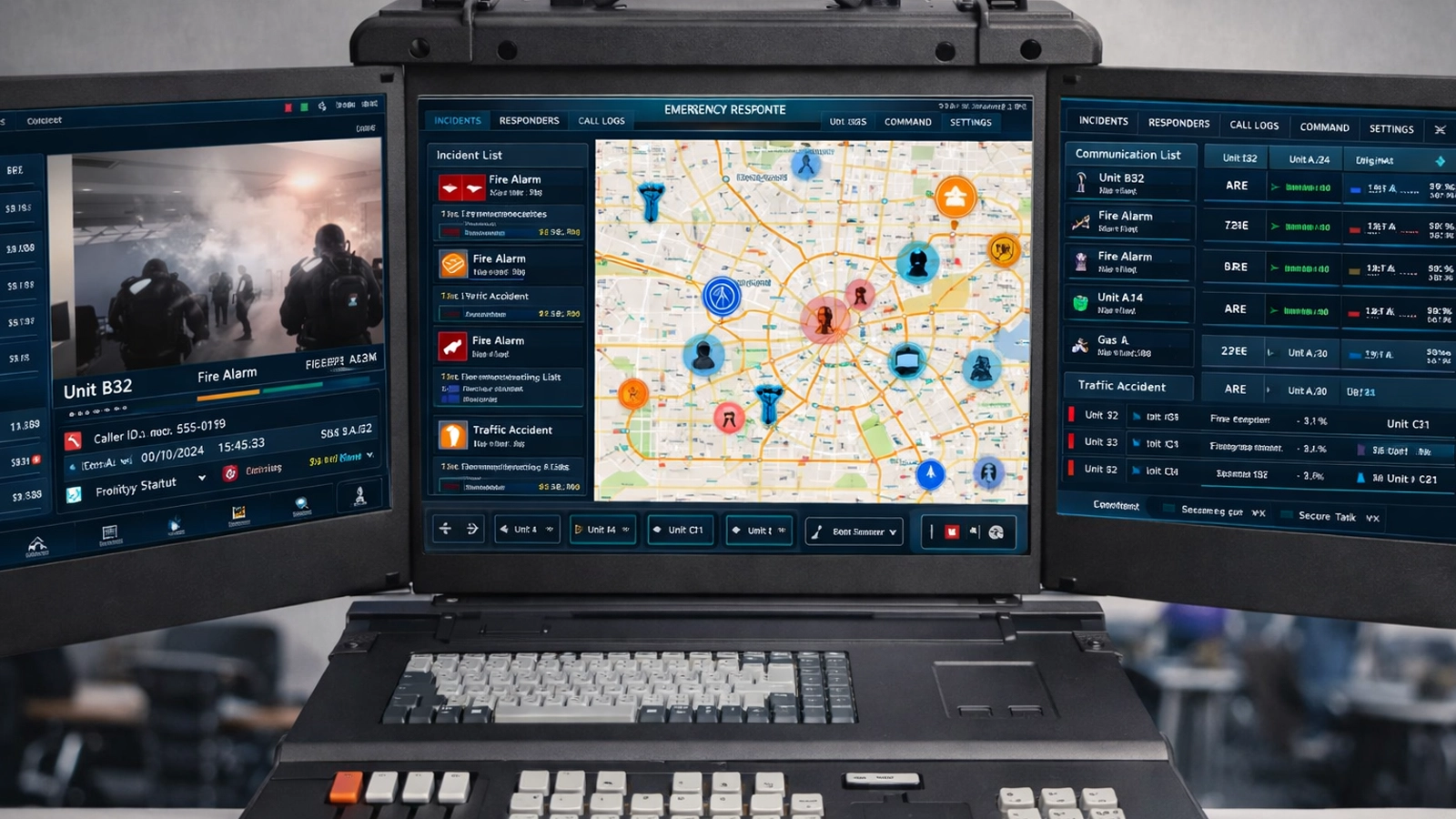
Overview: Emergency command centers use real-time dashboards to display critical information about the incident. These dashboards aggregate data from various sources – such as GPS locations of responders, sensor data from the field, maps of the affected area, and status updates from different agencies – into a single, intuitive interface. This allows emergency managers to quickly assess the situation and make informed decisions.
Examples: During a wildfire, a dashboard might show the locations of fire crews on the map, the current fire perimeter, weather conditions, and resource availability. In a disaster like an earthquake, a dashboard could display the locations of people requesting help (from 911 calls or apps), the status of infrastructure (power outages, road closures), and the deployment of emergency resources. Modern dashboards often use interactive maps, charts, and color-coded indicators to highlight key information.
Benefits: Dashboards provide a common operating picture for all responders, ensuring everyone is on the same page. They improve situational awareness and enable faster response by giving managers a high-level view of the situation and allowing them to drill down into details as needed. Visualization tools can also help in identifying trends (e.g. which areas are most affected) and prioritizing actions.
Overview: Accurate mapping and location tracking are essential for emergency response. GIS (Geographic Information System) software allows responders to plot incidents on maps, overlay relevant data (like roads, buildings, evacuation routes), and track the movement of assets and personnel. Location tracking systems use GPS and other technologies to keep tabs on the location of first responders, vehicles, and even victims in real time.
Examples: A responder’s smartphone or GPS-enabled device can report its location to a central server, which updates a map in real time. This helps commanders know where each team is positioned. In a search and rescue scenario, search teams can use GPS to record their progress and send back waypoints. Mapping software can also integrate with sensors – for instance, live video feeds from drones can be overlaid on a map to show the current state of a disaster site.
Benefits: Real-time location tracking improves coordination and safety. It allows managers to deploy resources efficiently and to ensure that help is directed to the right place at the right time. Mapping tools also help in planning response strategies (e.g. identifying the fastest routes to an incident or areas most in need of aid).
Overview: Artificial Intelligence (AI) and automation are increasingly being applied to emergency response to enhance communication and decision-making. AI can analyze large volumes of data quickly, predict outcomes, and even automate certain tasks. For example, AI algorithms can sift through emergency calls or social media posts to identify urgent needs or to predict the spread of a disaster (like a wildfire or disease outbreak).
Examples: Some systems use AI to detect anomalies in sensor data – for instance, a sudden spike in temperature or unusual traffic patterns that could indicate a hazardous event. AI can also be used for natural language processing to summarize emergency messages or to provide real-time translation of communications in different languages. Automation can include things like automatic alerting (if certain conditions are met, an alert is sent without human intervention) or robotic assistance (like drones that can be remotely controlled to assess a disaster site).
Benefits: AI can process information faster than humans, leading to quicker response times. It can also reduce human error and bias in decision-making. For example, AI might be used to help dispatch prioritize which emergency calls to handle first based on severity. Automation can free up human operators to focus on more complex tasks by handling routine communications or alerts automatically.
Overview: Beyond radios and phones, specialized software is used to facilitate communication among emergency response teams. This includes group chat applications, messaging platforms, and collaboration tools that allow responders to send text messages, share files, and even conduct video conferences. These tools often integrate with the overall system – for example, sending an emergency message to a group of responders on a messaging app can be done from the same dashboard that tracks their locations.
Examples: Many emergency services use apps like Slack or custom-developed communication apps that are secure and optimized for offline use. In some cases, responders might use a secure group chat to share photos and updates from the field. Video conferencing tools (like Zoom or Microsoft Teams) are used to connect remote command centers or to have virtual meetings with experts or off-site agencies.
Benefits: Communication software allows for more flexible and detailed communication than traditional radios. Team members can share detailed information (like photos, documents, live video) and coordinate in real time. This can be especially useful when responders are spread out or when multiple agencies need to collaborate. Some tools also have features like encryption and offline support, ensuring that communication remains possible even in challenging conditions.
Overview: Modern emergency response solutions often leverage cloud computing and integration of various systems. Cloud-based platforms allow different software tools to communicate with each other and to share data in real time. This means that, for example, location data from a responder’s GPS can feed into a dashboard and also trigger an alert if the responder is in danger.
Examples: Cloud-based emergency management systems can integrate GPS tracking, incident reporting, and communication modules into one platform. Data from a wireless mesh network can be sent to the cloud, where it is processed and made available to all authorized users. Similarly, cloud services can store and share incident reports, maps, and other information so that teams can access the latest data from anywhere.
Benefits: Integration and cloud computing enable a unified and scalable system. Data can be centralized, making it easier to maintain and update. It also allows for better collaboration, as different agencies or teams can access the same information simultaneously. Cloud solutions are also often more scalable – they can handle sudden spikes in data (like during a large disaster) without performance degradation, and they can be accessed from any location with an internet connection.
In summary, software and digital tools play a pivotal role in emergency response communication by providing situational awareness, improving coordination, and enabling faster, more informed decision-making. These tools, when combined with the appropriate communication technologies, form a comprehensive solution for managing emergencies effectively.
Deploying an emergency response communication solution involves careful planning of network architecture and infrastructure. Key considerations include network topology, redundancy, scalability, security, interoperability, and remote access. Here we outline these architectural considerations:
The network architecture should be designed to support the required communication needs. Common architectures for emergency networks include:
The architecture must be chosen based on the specific needs of the emergency and the available resources. For instance, a city-wide emergency might use a hierarchical model with a central command center connected to fire stations, police precincts, etc., whereas a rural search and rescue might use a mesh architecture with nodes spread out in the field.
Redundancy is a critical element of any emergency communication system. Multiple communication links should be provided so that if one fails, another can take over. This can include redundant networks (e.g. a cellular link and a satellite link as backups for each other), redundant power supplies for equipment, and backup servers or data centers.
For example, if a primary cellular connection is lost during a hurricane, responders should have a backup satellite connection to stay in touch. Similarly, if a key server goes down, there should be a secondary server ready to take its place. Redundancy also extends to physical infrastructure – having multiple entry points for network connections and multiple routes for data transmission can prevent a single point of failure.
The system must be able to scale to accommodate increasing numbers of users and data as the emergency evolves. This means the network should be able to handle a surge in communication volume (e.g. thousands of emergency calls or messages at once) and an increase in the number of devices connected (hundreds of responders and vehicles in the field). Scalability can be achieved through load balancing, cloud-based services, and modular hardware.
For instance, using a cloud-based communication platform means that as more users join (like additional fire departments or military units arriving to assist), the system can automatically scale to include them without requiring additional physical infrastructure. Similarly, having modular mesh routers allows adding nodes to expand coverage in large disaster areas.
Security is paramount in emergency communications. All data transmitted should be encrypted to prevent interception. This includes voice communications (using encrypted radio channels or encrypted VoIP), data transmissions (using VPNs or encrypted protocols), and even the storage of sensitive information (like personal data of victims or emergency plans) should be protected.
Key security measures include using strong encryption algorithms (like AES for data encryption), implementing secure protocols (like TLS for internet communication), and access controls that limit who can view or send information. Security should also extend to the physical devices – ensuring that radios and computers used in the field are protected against tampering or theft.
Additionally, network security in emergency situations can be challenging. Agencies must be prepared for potential cyber threats (such as hacking or malware) and have incident response plans in place to mitigate any security breaches.
An emergency response system must support interoperability between different agencies and technologies. This means ensuring that different radio systems can communicate, different software platforms can exchange data, and different devices (from different manufacturers) can work together. Standards are crucial here – for example, using a common radio frequency band or a common protocol for data sharing (like APCO P25 for digital radio, or standard APIs for software integration).
Agencies often use protocols like DMR or P25 for radio interoperability, and they may use common databases or formats for data (like GeoJSON for maps, or standardized incident reporting formats). Interoperability testing and training are also important – responders should practice using each other’s equipment and systems to ensure smooth collaboration during an actual emergency.
Many emergency response tasks are now done remotely, especially in large-scale disasters. Remote access refers to the ability of off-site personnel (like disaster coordinators, experts, or even family members of victims) to connect to the emergency network and participate in the response. This could involve remote command centers, telemedicine consultations, or remote monitoring of sensors.
To enable remote access, the system should have secure VPN connections, cloud-based collaboration tools, and possibly remote control capabilities for equipment (like controlling a drone or activating a remote sensor). It’s also important to ensure that remote connections are secure and that the remote users do not inadvertently disrupt the local operations.
In summary, the architecture of an emergency response communication solution must be robust, flexible, and secure. By considering these architectural aspects – from network design and redundancy to security and interoperability – agencies can build a system that can effectively handle the challenges of an emergency, providing reliable communication when it’s needed most.
To illustrate the effectiveness of an emergency response communication solution, we examine several real-world case studies. These examples highlight how different communication technologies and systems were used in actual emergencies to coordinate response efforts and save lives:
Background: Hurricane Irma, one of the most powerful Atlantic hurricanes on record, struck the Caribbean and Florida in September 2017. It caused widespread destruction, knocking out power and communication infrastructure in many areas.
Communication Challenges: The hurricane severely damaged cellular towers and power grids in the affected regions. This led to widespread loss of mobile phone service and internet access. First responders and residents were cut off from normal communication channels.
Response and Communication Solution: In the aftermath of Irma, a multi-faceted communication solution was employed:
Outcome: Despite the extensive damage, the combination of these communication methods helped save lives and coordinate the response. First responders were able to communicate with each other and with command centers, enabling effective evacuation and rescue operations. The public was warned through various channels, reducing casualties. The use of satellite communication was particularly crucial – it allowed relief organizations to maintain contact with remote areas that were cut off from the mainland. This case demonstrates the importance of having multiple communication layers in place for disaster resilience.
Background: The Camp Fire, a devastating wildfire in California in November 2018, destroyed the town of Paradise and became the deadliest and most destructive wildfire in California history.
Communication Challenges: The fire spread rapidly, cutting off power lines and cell towers. Within hours, thousands of residents were left without power and phone service. This isolation made it extremely difficult for emergency responders to coordinate with each other and with the public.
Response and Communication Solution: The response to the Camp Fire relied on a combination of traditional and innovative communication techniques:
Outcome: The Camp Fire highlighted the importance of redundancy in communication. While cell towers were down, the use of radios and other systems allowed firefighters to continue their work. Public alerting and social media kept the public informed, though some residents still struggled to get information in the immediate aftermath. The incident also underscored the need for emergency broadband – several communities with Starlink or similar services were able to maintain some connectivity, which aided in both communication and coordination. Overall, the response was hampered by the lack of communication, but agencies adapted by using whatever means were available, including innovative solutions like community apps and satellite devices. This case study shows the importance of having not only traditional systems but also modern tools and backup communication methods for wildfire response.
Background: The COVID-19 pandemic, declared in early 2020, presented a unique emergency requiring new forms of communication. Governments worldwide had to communicate with the public about health risks, lockdowns, and vaccination efforts, while also coordinating healthcare responses and research.
Communication Challenges: The pandemic necessitated frequent and urgent communication with the public and between healthcare professionals. It also involved managing vast amounts of data and coordinating across borders. Traditional public alert systems were used, but the scale of the crisis meant new methods were needed, such as mass media campaigns, public health hotlines, and digital platforms for remote consultations.
Response and Communication Solution: The response to COVID-19 involved a broad communication strategy:
Outcome: The COVID-19 response demonstrated the importance of effective communication in a public health emergency. Public alerting helped to ensure that people followed guidelines, which was crucial in slowing the spread of the virus. Telehealth innovations allowed medical care to continue without overwhelming hospitals. The use of data and dashboards provided transparency and helped governments make data-driven decisions. However, the pandemic also highlighted some communication challenges – misinformation spread rapidly on social media, and not all populations had equal access to digital communication tools. Nonetheless, the widespread adoption of digital communication technologies during this crisis paved the way for more robust emergency communication strategies in the future, especially in health emergencies.
Background: A devastating earthquake struck southern Turkey and northern Syria in February 2023, killing tens of thousands and causing widespread destruction. The region’s infrastructure was severely damaged, including many communication towers.
Communication Challenges: The earthquake cut off phone service and internet in large areas. Many residents were trapped in collapsed buildings with no way to call for help. Coordinating rescue efforts across the affected region was extremely difficult without communication.
Response and Communication Solution: The response to the Turkey-Syria earthquake utilized a mix of technologies to re-establish communication:
Outcome: The earthquake highlighted the critical role of communication in search and rescue. Thanks to the use of satellite phones and mesh networks, many survivors were reached and rescued, and vital information was relayed back to command centers. Public alerting ensured that people knew to evacuate, although in some cases the rapid collapse caught many by surprise. Social media proved to be both a blessing and a curse – it helped coordinate global aid and locate survivors, but it also contributed to misinformation and scams. The case underscores the need for robust emergency communication plans, including having backup systems (like satellite and mesh) ready to deploy immediately after a disaster. It also shows how community-driven communication (using smartphones) can supplement official channels in the chaos of an earthquake.
Background: Hurricane Florence, a Category 4 hurricane that struck the Carolinas in September 2018, brought heavy rain and flooding. It caused significant damage to infrastructure, including many cell towers.
Communication Challenges: The hurricane knocked out cell service in large areas, making it difficult for residents to communicate with each other or with emergency services. Power outages also affected landline and internet services.
Response and Communication Solution: The response to Hurricane Florence used several communication methods:
Outcome: Despite the extensive damage, the combination of these communication methods helped mitigate the impact. First responders were able to stay connected and coordinate rescues, and the public was informed through multiple channels. The use of wireless mesh networks and public Wi-Fi was particularly effective in providing internet access in areas where it was lost. Public alerting ensured that residents were aware of the dangers and evacuation orders. However, the sheer scale of the storm meant that not all areas were reached immediately, and some residents still faced challenges getting information. The Florence case study reinforces the importance of having both traditional and modern communication tools ready for hurricane response – from radios and sirens to mesh networks and mobile apps – to ensure that information flows freely when it’s needed most.
Effective emergency response communication is the lifeblood of any disaster management effort. As we have seen, a robust emergency response communication solution must integrate multiple technologies and systems to ensure that information flows freely in times of crisis. From wireless mesh networks that provide local connectivity when everything else fails, to satellite systems that extend coverage to the farthest corners of a disaster zone, and from traditional UHF radios that enable immediate voice coordination on the scene, to modern software tools that enhance situational awareness and collaboration – each component plays a crucial role.
Key requirements such as resilience, speed, coverage, interoperability, security, adaptability, and user-friendliness must be met through careful architecture and deployment. By designing networks with redundancy and failover, ensuring interoperability across different agencies and technologies, and using secure and user-friendly systems, emergency responders can significantly improve their ability to save lives and property.
Real-world case studies further illustrate the importance of these solutions. Whether it’s the resilience of wireless mesh in Hurricane Irma, the use of satellite and social media in the Camp Fire, the innovation in telehealth during the COVID-19 pandemic, the rapid deployment of communication tools in the Turkey earthquake, or the multifaceted approach in Hurricane Florence – in every scenario, the availability of reliable communication made a difference. It enabled first responders to coordinate, informed the public, and provided a lifeline for those in need.
In conclusion, an emergency response communication solution is not a single technology but a comprehensive strategy. It combines hardware, software, and human coordination to ensure that during the chaos of an emergency, information is shared swiftly and accurately. By continuously improving and adapting these solutions – investing in backup systems, training responders on new tools, and learning from past experiences – emergency management agencies can build a communication infrastructure that is truly prepared for any crisis. In the end, the goal is clear: to enable communication that saves lives, protects communities, and facilitates the efficient and effective response to emergencies.