
IndustryInsights
In emergency command, public safety, energy, utilities, transportation, and other mission-critical sectors, two-way radios remain one of the most trusted communication tools for frontline teams. They are fast, direct, reliable, and well suited to demanding field environments where communication must continue without delay.
However, many organizations still face the same long-standing challenge: radio systems are often built on different standards, frequencies, brands, and network structures. As a result, field teams may all be communicating, but not necessarily with each other. At the same time, command centers increasingly rely on unified communications and dispatch platforms, creating a gap between modern control-room systems and legacy or independent radio networks.
Becke Telcom trunked radio gateway solutions are designed to close that gap. By connecting private radio systems, public network push-to-talk platforms, and SIP-based dispatch environments, the gateway helps organizations build a practical interoperability layer for daily coordination and emergency response.

In many real-world deployments, police, fire services, industrial security teams, railway crews, utility operators, and emergency response units may all use different radio systems. These systems may differ by brand, operating band, signaling method, or network type. Some organizations use conventional radio, while others rely on trunked systems. In parallel, many teams have also introduced public network push-to-talk services over 4G or 5G.
This creates a fragmented communication environment. Each group may be able to communicate internally, but cross-team collaboration becomes difficult when platforms do not interconnect. During normal operations this causes inefficiency. During incidents, it can delay coordination, reduce situational awareness, and make unified command more difficult to achieve.
Many organizations have invested in unified communications systems or command-and-dispatch platforms that can support voice, video, conferencing, alarm handling, and monitoring integration. These platforms are powerful, but one common limitation remains: they often do not connect directly to the field radio network.
That means the dispatcher may operate from an advanced SIP-based platform while frontline responders continue to use handheld or mobile radios on a separate system. Without an interoperability gateway, communication between the two sides often depends on manual relay, which adds friction at exactly the moment when response speed matters most.
The real challenge is not whether an organization has radios or a dispatch platform. The challenge is whether those systems can work together as one operational communication environment.
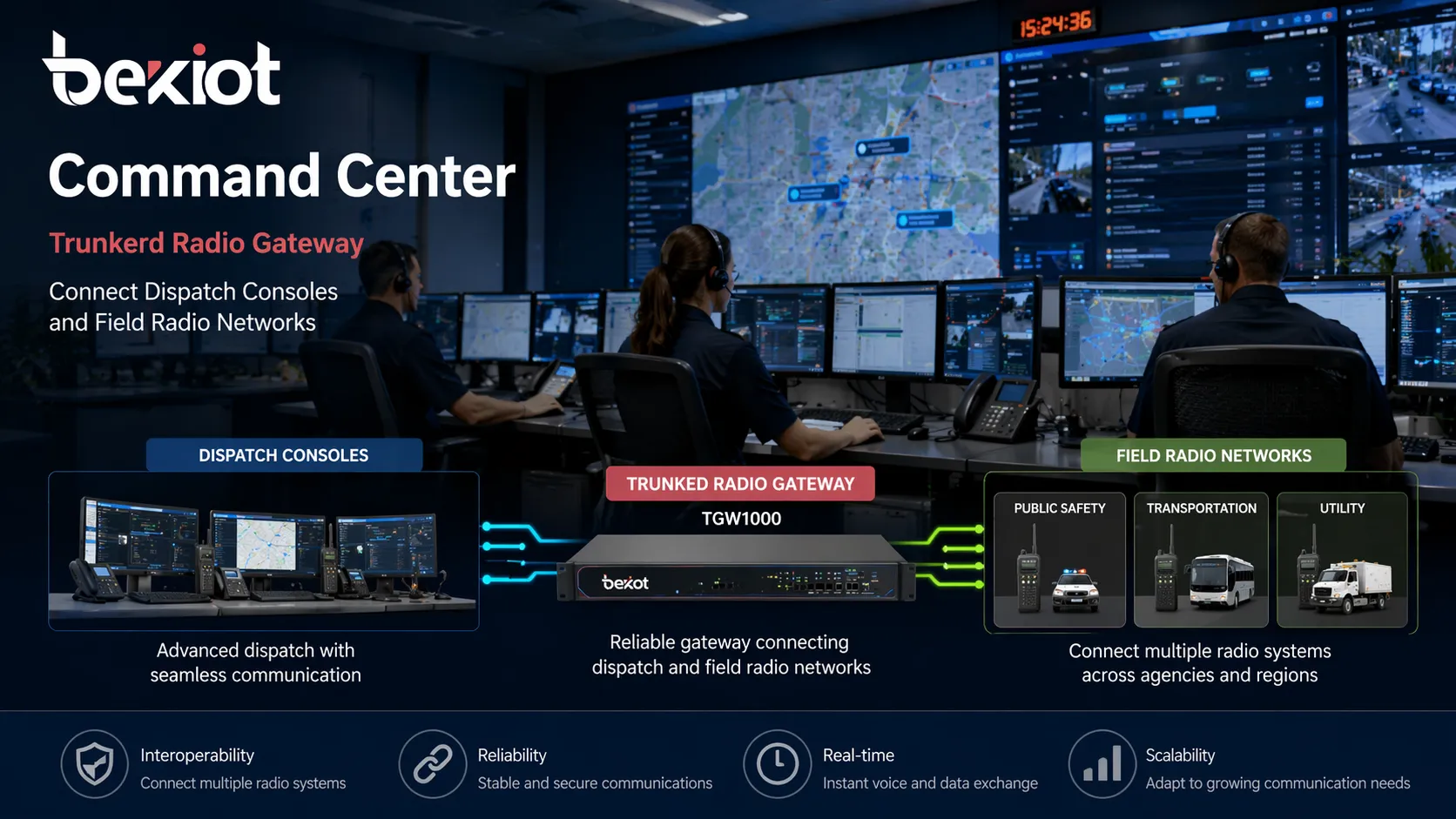
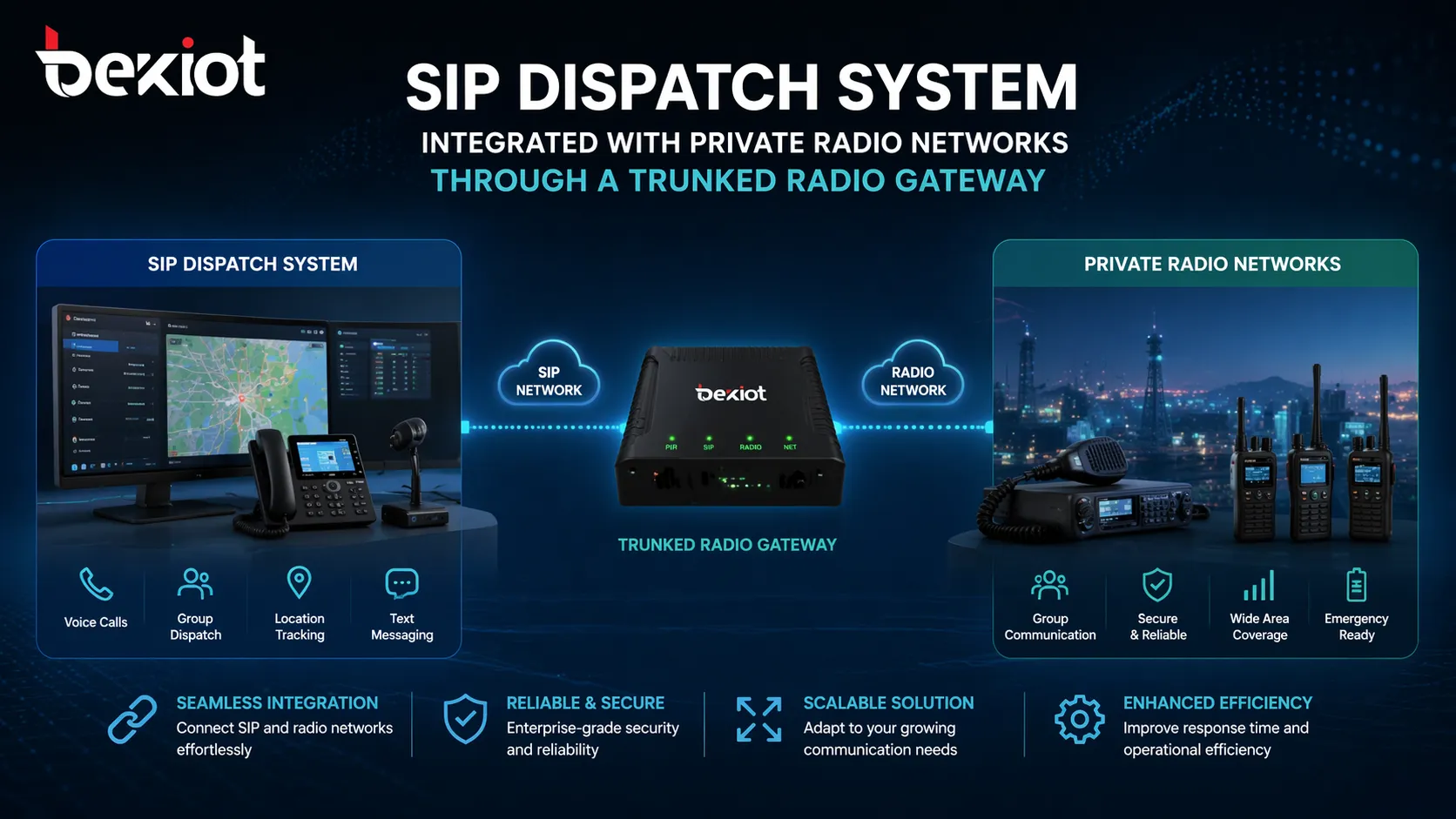
One of the most common deployment models is to connect the radio system into an existing unified communications or command platform. In this scenario, the trunked radio gateway converts radio audio and related control behavior into standard SIP-based communication, allowing the dispatch platform to interact with radio users more directly.
After integration, dispatchers can call or communicate with field radio users from the same system they already use for voice, video, and operational coordination. Frontline users can continue to work on familiar radio devices, while the command center gains better visibility and more direct reach into field communications. Instead of treating radio as an isolated subsystem, the organization can bring it into the broader command workflow.
This model is particularly suitable for command center projects, integrated dispatch deployments, and video collaboration environments that also need live radio audio participation.

Public network push-to-talk platforms have become increasingly popular because they offer wide coverage, flexible deployment, and lower entry costs in many scenarios. Yet organizations that already operate private radio networks often discover that public push-to-talk and private radio remain two separate communication worlds.
Becke Telcom trunked radio gateways can be used to bridge these environments. In suitable deployments, the gateway can work with the PoC platform at the signaling level rather than only passing raw audio. This allows more natural communication behavior, including coordinated talk control between the public network side and the private radio side.
When properly integrated, the result is a smoother user experience with lower delay and more practical real-time coordination. This approach is valuable for organizations that have already adopted public network push-to-talk but still need to stay connected to legacy or mission-critical radio assets.
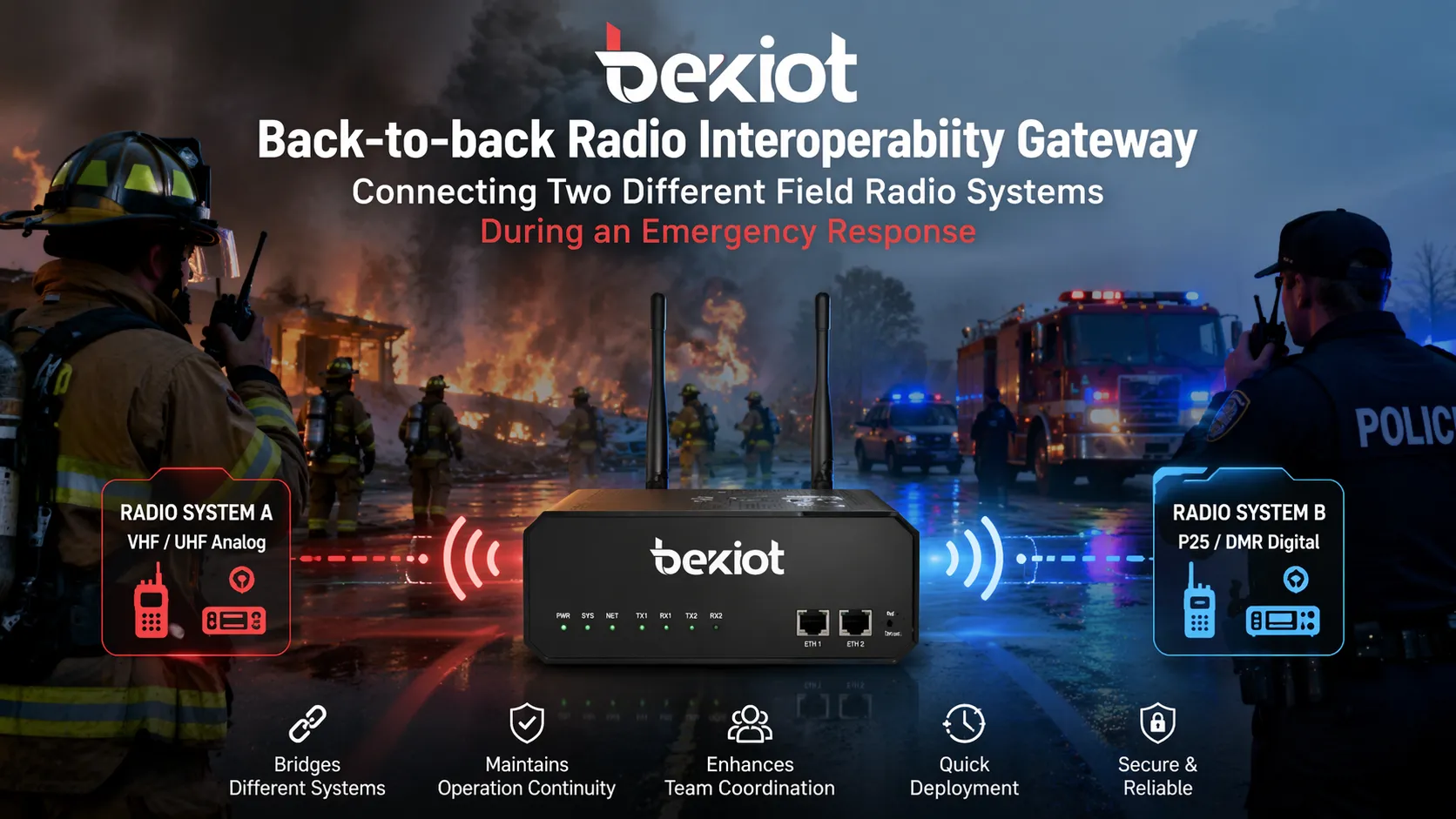
Some field scenarios are more direct. There may be no dispatch platform involved and no public push-to-talk platform in the middle. The task may simply be to let two groups using different radios talk to each other quickly. For temporary operations, joint response, and rapid on-site coordination, the back-to-back gateway model is often the most straightforward option.
In this configuration, one radio interface connects to one system and another interface connects to a second system, with the gateway acting as the bridge. Voice from one side is passed to the other, enabling immediate communication across otherwise isolated radio environments. This can be especially useful during multi-agency response, temporary interoperability missions, or field deployments where rapid setup is more important than complex infrastructure.
To support these scenarios, a professional gateway may provide multiple activation and detection methods such as PTT control, VOX voice activation, and carrier-related detection logic, helping ensure reliable switching and more complete audio capture during live use.

Becke Telcom trunked radio gateway solutions are built to help organizations connect different radio environments more effectively. They can support integration between field radios, SIP-based unified communications systems, command-and-dispatch platforms, and compatible public network push-to-talk environments.
This interoperability approach is not only about passing audio. It is about making communication across systems practical in real operations. By reducing separation between field users and command systems, the gateway helps organizations create a more connected response framework.
Interoperability requirements vary widely by industry and mission. Some projects need a fixed rack-mounted integration point in a control room, while others need a compact and fast deployment method for temporary or transitional operations. A trunked radio gateway is valuable because it can be adapted to both long-term infrastructure and event-based coordination tasks.
For command centers, the gateway can become part of a larger converged communications architecture. For incident scenes, it can serve as a practical bridge between teams that were not originally equipped to communicate on the same network. This flexibility makes it relevant across public safety, emergency management, transport, utilities, industrial plants, and defense-related environments.
In mission-critical communication, complex theory matters less than dependable execution. Equipment must be manageable, stable, and easy to configure. A well-designed gateway should therefore support clear web-based configuration, practical status monitoring, and straightforward interface management, allowing integrators and operators to deploy and maintain the system efficiently.
For organizations that need to connect diverse communication resources without replacing every legacy endpoint, this kind of gateway provides a pragmatic path forward. It preserves existing radio investment while extending communications into a broader IP and dispatch ecosystem.
Instead of forcing every team onto one device type or one network model, a gateway-based approach allows different systems to remain in service while still participating in a unified operational communications structure.
Police, fire, rescue, and emergency management teams often need to coordinate across agencies that use different communication resources. A trunked radio gateway can support interoperability between command platforms and frontline radios, helping reduce communication barriers during incident response, event security, and daily coordination.
This is particularly valuable in multi-agency operations where response teams must share updates quickly but cannot depend on native radio compatibility across every participating unit.
Power utilities, substations, oil and gas sites, and large industrial campuses often use radio for field dispatch, maintenance coordination, and safety communication. At the same time, control rooms increasingly rely on IP-based command environments and integrated operational systems.
By connecting radio communications into a unified dispatch architecture, organizations can improve coordination between field teams and control centers while keeping proven radio workflows in place for harsh or remote environments.
Railway operations, metro systems, airports, ports, and road infrastructure projects all depend on fast and dependable communication between mobile teams and centralized operations. In many cases, different contractor groups, operating departments, or emergency support teams use different communication tools.
A trunked radio gateway can help bridge these systems, making it easier to support joint operations, incident handling, maintenance dispatch, and temporary cross-team collaboration without requiring a complete communications overhaul.
Two-way radios are still essential on the frontline, and unified command platforms are now essential in the control room. The real operational requirement is not to choose one over the other, but to make them work together.
Becke Telcom trunked radio gateway solutions help organizations connect radio users, dispatch operators, and cross-network communication resources into a more practical and responsive system. Whether the objective is radio integration into a SIP dispatch platform, interworking between PoC and private radio, or fast back-to-back interoperability in the field, the gateway provides a clear path toward more unified communications.
For organizations building modern command and dispatch environments, radio interoperability is no longer an optional enhancement. It is a core capability for communication continuity, coordinated response, and efficient operations.
A trunked radio gateway is a device that connects radio systems with other communication platforms, such as SIP-based unified communications systems, dispatch consoles, or compatible push-to-talk environments. Its main purpose is to enable voice interoperability between systems that would otherwise remain isolated.
Yes. One of the most common uses of a trunked radio gateway is to connect private or trunked radio systems to SIP-based command and dispatch platforms. This allows dispatchers to communicate more directly with radio users from within the unified platform environment.
Yes, in many cases it can. When the public push-to-talk platform provides suitable interface support, the gateway can help bridge public network communications with private radio systems, making cross-network voice coordination more practical.
Yes. Back-to-back deployment is especially useful for temporary operations, incident response, and field coordination where two different radio systems need to interoperate quickly without relying on a large central platform.
Typical industries include public safety, emergency management, utilities, energy, rail, transport, industrial operations, ports, and other critical infrastructure sectors where radio communication remains essential but system interoperability is limited.