
百科全書
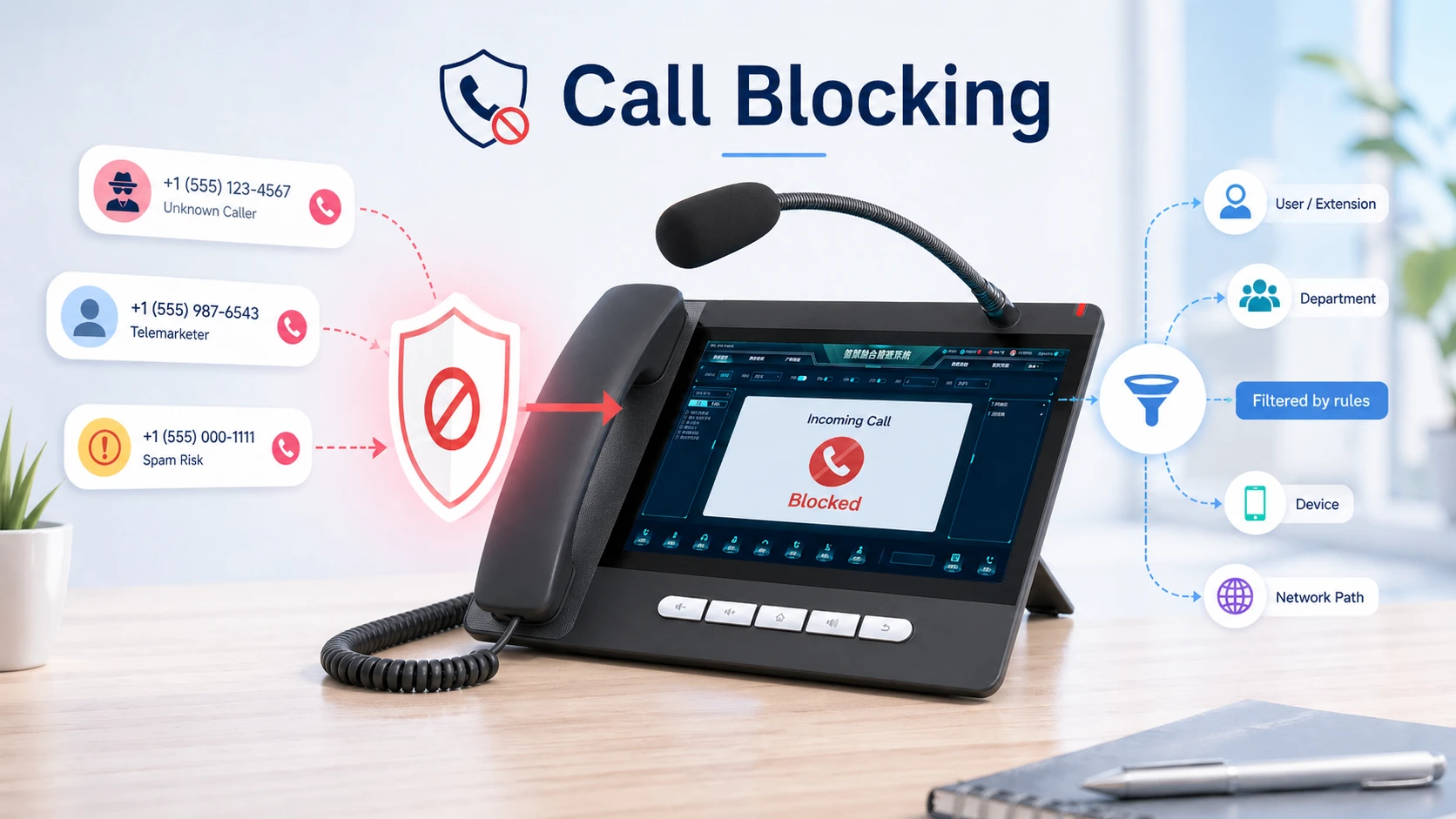
Call blocking is a telephony feature that prevents certain calls from reaching a user, extension, department, device, or network path based on defined rules. In simple terms, it allows the phone system or communication platform to reject, suppress, or filter calls that match specific conditions. Those conditions may include unwanted caller numbers, anonymous calls, restricted destinations, spam patterns, policy rules, or service restrictions.
Although the idea sounds straightforward, call blocking plays a very important role in real communication systems. It is used not only for personal privacy, but also for business call control, fraud prevention, internal policy enforcement, customer service workflow protection, and communication security. In enterprise telephony, IP PBX systems, SIP environments, contact centers, and office communications, call blocking helps keep voice traffic more manageable and more aligned with actual operational needs.
In practical deployment, call blocking is not just about stopping nuisance calls. It is also about deciding which calls should not be allowed into a communication environment, which destinations users should not dial, and which calling behaviors may create cost, risk, or disruption. That is why call blocking is often treated as both a user-facing feature and a system-level control mechanism.
Call blocking is the process of preventing a call from being completed based on predefined criteria. The blocked call may be incoming or outgoing, and the blocking rule may be applied by a desk phone, mobile handset, PBX platform, SIP server, carrier service, unified communications platform, or enterprise telephony policy engine.
The core meaning of call blocking is controlled call denial. Instead of letting every call connect automatically, the communication system checks whether the call matches a rule that says it should be refused, filtered, or stopped. This makes the voice platform more selective and more manageable.
In everyday use, people often think of blocking as rejecting a nuisance caller. In professional communication systems, however, the meaning is broader. A company may block international dialing for certain users, stop anonymous calls to executive lines, prevent after-hours routing to particular departments, or reject known spam sources before they reach agents.
Call blocking is not simply a way to refuse calls. It is a way to control which calls are allowed to become part of the communication process.
In real communication environments, not every call is useful, safe, or relevant. Some calls may be spam, harassment, fraud attempts, misdials, unauthorized destination attempts, or unnecessary interruptions. If the system accepts all call activity without control, users and teams may spend too much time dealing with calls that should never have entered the workflow at all.
Call blocking matters because it reduces that unwanted load. It helps protect users from nuisance communication, protects organizations from policy violations and cost abuse, and improves the overall order of the communication environment. A blocked call never becomes a distraction for the staff member who would otherwise need to answer or manage it.
This is why call blocking is often treated as a practical communication hygiene function. It helps keep voice systems cleaner, safer, and more focused on legitimate traffic.
The basic mechanism usually begins when a call is initiated or received. Before the call is fully connected, the system checks available information such as the caller number, called number, caller identity status, trunk source, user permissions, dial pattern, time policy, or service class. If the call matches a blocking rule, the system prevents it from completing.
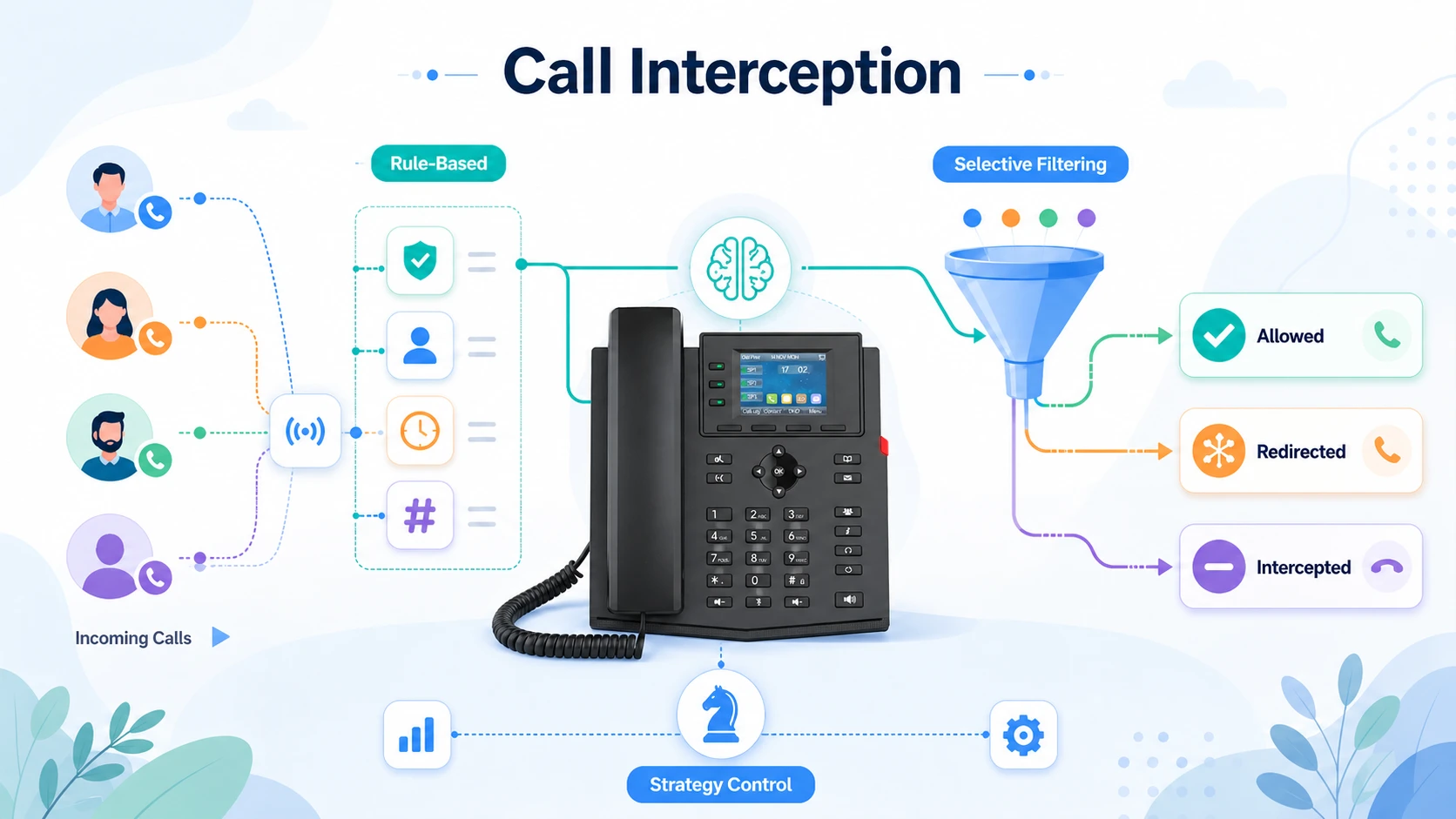
Depending on the platform, the blocked call may be rejected silently, routed to a recorded announcement, returned with a busy tone, dropped with a denial message, redirected to voicemail, or logged for administrative review. The exact behavior depends on the communication policy and the design of the system.
This process happens quickly and often invisibly. From the user’s perspective, the unwanted call simply does not proceed. Behind the scenes, however, the communication platform has performed a rule-based decision before allowing the session to become active.
Call blocking can happen at different layers. Some blocking is performed on the endpoint itself, such as a user blocking a specific number on a desk phone or mobile device. Other blocking is managed centrally on a PBX, SIP server, or cloud communication platform, where the policy can apply across departments or users. In some cases, the carrier or upstream service provider also performs blocking before the call even reaches the enterprise environment.
This layered model is important because different communication risks are better handled at different points. Personal nuisance calls may be blocked locally. Company-wide toll restrictions may be blocked centrally. Large-scale spam prevention may be more effective at the service-provider layer.
In practical deployment, the strongest call blocking strategies often combine more than one layer of control.
A call blocking system is most effective when it stops the call at the most appropriate point in the communication path, not only after the user is already disturbed.
One of the most important characteristics of call blocking is that it is rule-based. The system does not normally block calls randomly. It blocks them because they match defined criteria. Those criteria may be simple, such as one specific number, or more complex, such as whole number ranges, caller identity conditions, destination classes, or organizational service rules.
This rule-based nature makes call blocking predictable and manageable. Administrators can define what is blocked, why it is blocked, and to whom the rule applies. Users can often understand the logic instead of experiencing unexplained communication failure.
In enterprise telephony, this policy-driven approach is essential because call restrictions often need to reflect business structure, cost control, security requirements, and different user roles across the organization.
Another key characteristic is selectivity. Call blocking is not meant to stop all calls. It is meant to stop the wrong calls while allowing valid communication to continue. This distinction is very important because an overly broad blocking rule can damage business communication just as much as an absent rule can allow abuse.
Good call blocking systems therefore focus on accuracy. They aim to block nuisance, unauthorized, or harmful traffic without interfering with legitimate callers, necessary outbound dialing, or approved service paths. This requires careful rule design and ongoing review.
In practical use, selectivity is what separates useful call blocking from blunt communication restriction.
Incoming call blocking is used to stop certain external or internal calls from reaching the destination user or group. This may include blocking known spam numbers, anonymous callers, restricted caller IDs, blacklisted ranges, or nuisance sources that repeatedly attempt unwanted contact.
In customer-facing or office environments, incoming blocking helps reduce interruptions and protects staff from low-value or harmful traffic. In more sensitive communication settings, it can also improve privacy and reduce social engineering exposure.
This type of blocking is one of the most familiar forms of the feature because users can often see its benefits directly in daily communication.
Outgoing call blocking prevents users or extensions from calling certain destinations or classes of numbers. This may include international routes, premium-rate services, unauthorized mobile numbers, restricted external lines, or non-business destinations. In enterprise telephony, this type of control is often tied to policy and cost management.
Outgoing blocking is especially important where many users share one communication platform and not all of them should have the same dialing privileges. A basic office extension, a lobby phone, and an administrator console may all require different outbound permissions.
In practical deployment, outgoing call blocking often supports both financial control and system security.
Many call blocking systems support blacklist entries, pattern matching, and identity-based conditions. Administrators or users may block one number, a set of prefixes, anonymous calls, hidden caller IDs, or calls from specific regions or service classes. This makes the feature much more flexible than a one-number filter alone.
Pattern-based logic is especially useful because communication problems often do not come from only one source. Spam campaigns, fraud attempts, or unwanted traffic may appear across number ranges rather than one repeated number. A stronger blocking feature therefore usually includes matching logic rather than only manual one-by-one entries.
This flexibility makes call blocking scalable in larger environments where many call events must be filtered consistently.
Another important feature is logging. In professional systems, blocked calls are often recorded in call logs, administrative reports, or security records. This helps organizations understand what is being blocked, whether the rules are working properly, and whether a traffic pattern suggests abuse or misconfiguration.
Administrative control is also important. Business communication systems often need centralized rule management so that policies can be applied consistently across teams, branches, or user groups. This is especially useful when blocking is part of a larger communication governance policy rather than a personal preference.
These features make call blocking useful not only in the moment of rejection, but also in long-term voice environment management.
One of the clearest advantages of call blocking is the reduction of nuisance communication. Unwanted calls consume attention, interrupt work, and lower efficiency. By preventing those calls from reaching the user or department, the system protects time and focus.
In individual use, this may simply mean fewer spam calls and fewer repeated interruptions. In enterprise environments, the advantage is often larger. Reception staff, support teams, and administrators do not need to spend working time handling traffic that should have been filtered out before it rang.
In practical terms, call blocking improves communication quality by reducing the amount of communication that does not deserve attention in the first place.
Call blocking also supports communication security. Fraud attempts, toll abuse, social engineering efforts, nuisance campaigns, and unauthorized outbound dialing can all create operational or financial harm. Blocking helps reduce these risks by preventing certain communication paths from being used at all.
This is especially useful in organizations with shared phone resources, public-facing extensions, or multiple classes of users. Not every user should have the same dialing rights, and not every incoming source should be allowed direct access to every endpoint.
In this sense, call blocking is not only a comfort feature. It is part of communication risk control.
The strongest benefit of call blocking is not simply fewer calls. It is fewer harmful, distracting, or unauthorized calls entering the communication workflow.
Call blocking helps make the communication environment more orderly by reducing traffic that does not belong there. This can improve the performance of reception workflows, support teams, administrative departments, and PBX-based office communications. When invalid calls are filtered out, valid calls are easier to see and handle properly.
This is particularly useful in busy environments where staff already manage significant call volume. Even a modest reduction in unwanted call traffic can improve answer focus and reduce operational friction.
In practical voice systems, order matters, and call blocking contributes to that order more than its simple name may suggest.
Another strength is that call blocking can be adapted to different scales of use. A single user may block one nuisance number. A business may block entire destination classes. A cloud voice provider may apply upstream spam filtering. This range of possible use cases makes the feature broadly useful across simple and advanced communication environments.
Because it can operate at user level, device level, PBX level, and service-provider level, call blocking is one of those telephony controls that fits almost anywhere. The exact form changes, but the practical purpose remains the same: prevent the wrong call from becoming an active burden.
This adaptability is one reason the feature remains relevant across both legacy and modern communication systems.
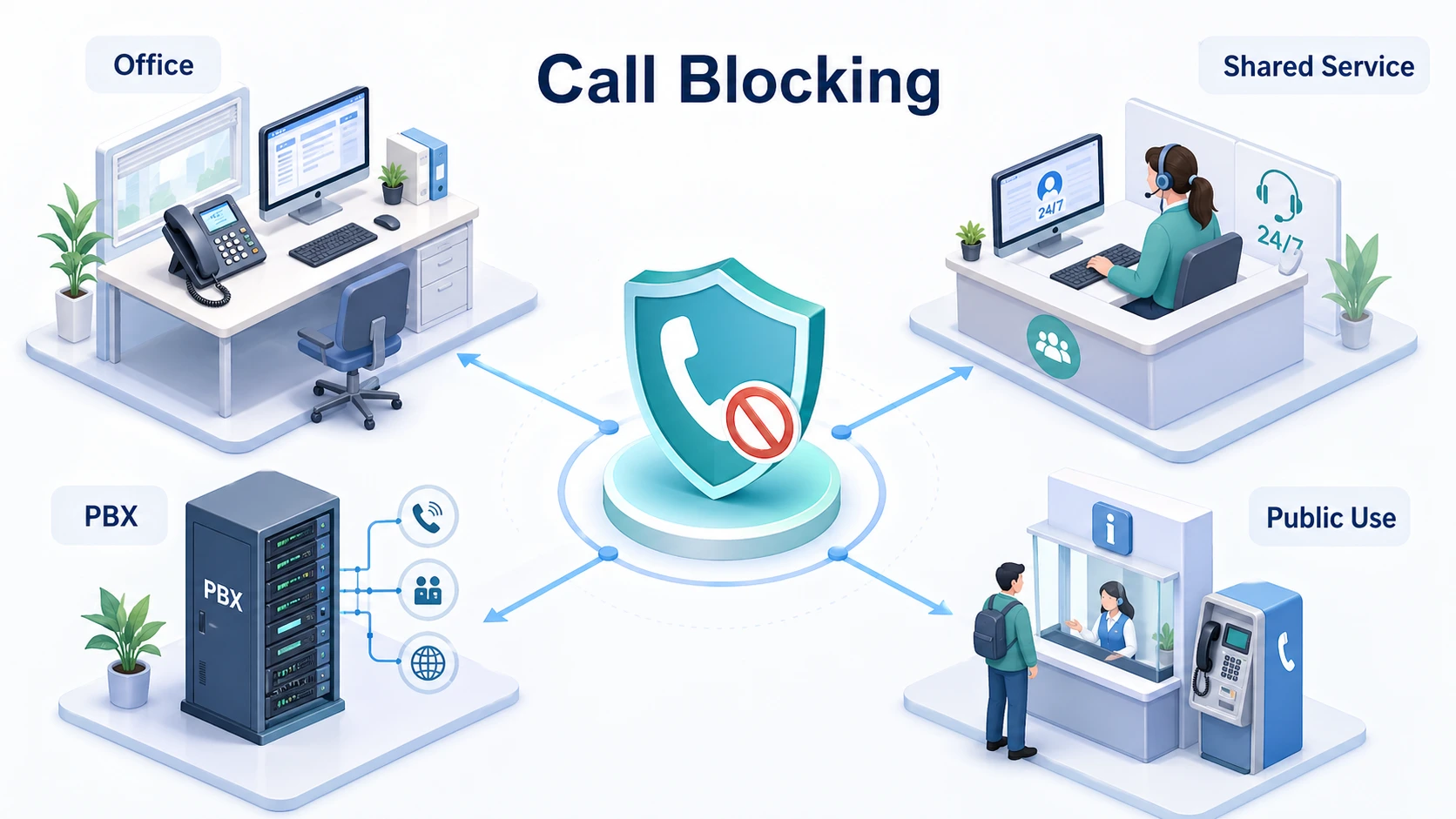
In office telephony and enterprise PBX systems, call blocking is often used to protect users from nuisance callers, restrict unauthorized outbound dialing, and enforce role-based communication policies. A front desk phone, executive extension, common-area phone, and support desk line may all require different levels of call permission and protection.
These environments benefit because telephony is part of daily workflow, and any unnecessary interruption can reduce efficiency. Blocking helps keep the communication platform aligned with actual business needs rather than treating every call as equally valid.
In this context, call blocking often becomes part of broader voice policy rather than a one-time user preference setting.
Customer service environments and shared service lines also use call blocking to reduce spam, repeated abuse, or invalid call traffic that would otherwise consume agent time. Public-facing numbers are particularly vulnerable because they are intentionally exposed and therefore more likely to receive unwanted activity.
Blocking in these environments helps preserve service resources for legitimate callers. It can also improve staff experience by reducing repeated exposure to nuisance traffic or abusive communication patterns.
In practical terms, this means call blocking supports service quality not only by what it allows, but also by what it keeps out.
One important best practice is to review blocking rules regularly. Communication patterns change, businesses change, and number lists evolve over time. A rule that was useful last quarter may become too broad, no longer necessary, or too narrow to handle current nuisance patterns.
Regular review helps ensure that the feature remains effective without becoming disruptive. It also helps identify whether blocked traffic patterns suggest a larger communication issue such as fraud attempts, repeated harassment, or misapplied policy logic.
In practical environments, call blocking works best when it is maintained as an active control rather than forgotten after initial setup.
Another important practice is restraint. Overly aggressive blocking can create service problems if legitimate customers, partners, internal users, or approved destinations are denied accidentally. This is particularly risky in businesses that depend on open communication with many external contacts.
Good call blocking design therefore aims for accuracy, not maximum denial. The goal is to remove harmful or irrelevant traffic while preserving valid communication paths. Logging and review help support this balance.
In practical terms, successful call blocking is selective and intelligent, not simply strict.
The best call blocking strategy protects the communication environment without shrinking it so much that legitimate contact becomes harder than it should be.
Call blocking is the feature that prevents certain incoming or outgoing calls from being completed based on rules, identities, number patterns, or organizational policy. Its main characteristics include rule-based behavior, selective filtering, flexibility across different system layers, and strong relevance to both privacy and communication control.
Its advantages include fewer nuisance interruptions, stronger security, better policy enforcement, and more orderly call management. It is widely used in enterprise PBX systems, office telephony, customer service lines, shared numbers, and policy-controlled communication environments where not every call should be allowed to proceed.
In practical communication systems, call blocking is not just a rejection feature. It is a control mechanism that helps keep the voice environment cleaner, safer, and more useful for the calls that actually matter.
In simple terms, call blocking means stopping certain calls from reaching a user or stopping certain outbound calls from being made. The system blocks calls based on rules such as numbers, patterns, caller identity, or policy.
It helps prevent unwanted or unauthorized communication.
The main characteristics are rule-based control, selective filtering, support for incoming and outgoing restrictions, and the ability to work at device, PBX, or carrier level. It is designed to block the wrong calls without interfering with valid ones.
This makes it both practical and manageable in real communication systems.
Call blocking is commonly used in office phone systems, enterprise PBX platforms, customer service lines, shared business numbers, personal devices, and cloud or carrier telephony services.
It is especially useful where spam, nuisance calls, policy enforcement, or outbound dialing control matter.